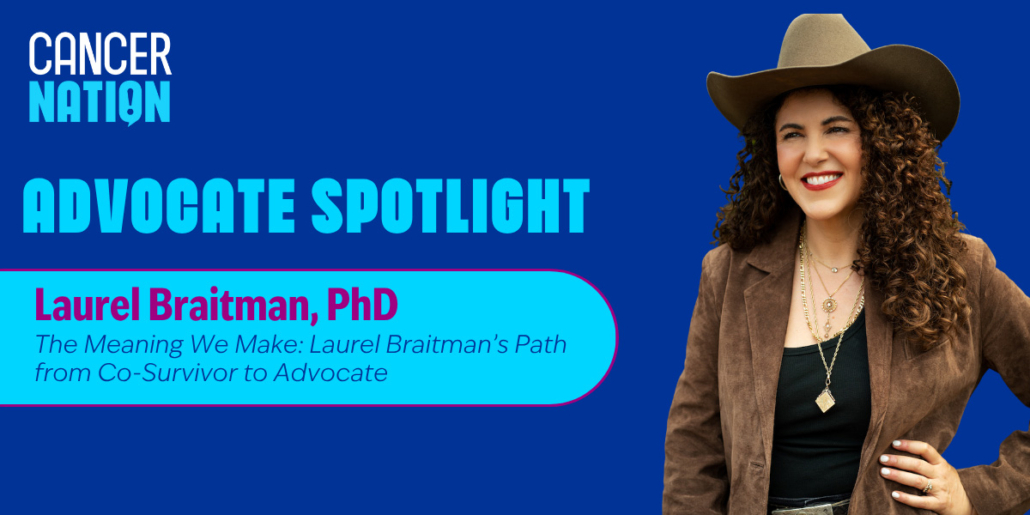
The Meaning We Make: Laurel Braitman’s Path from Co-Survivor to Advocate
Advocate Spotlight: Laurel Braitman

Photo Credit: Lauren Tabak
Laurel Braitman has spent her life at the intersection of story, healing, and human connection. As a writer, teacher, and the Director of Writing and Storytelling at the Stanford School of Medicine, she helps medical students, clinicians, and future health leaders learn how to speak to patients and families with clarity and compassion; not with jargon, but with humanity. She teaches them that communication is not an accessory to care. It is care. And it’s a lesson she learned long before she ever stepped into a classroom.
Cancer entered Laurel’s story early. Her father was ill from the time she was three until she was seventeen, and this reality shaped her childhood in ways most kids never have to imagine. In her memoir, What Looks Like Bravery, Laurel writes about those years with unforgettable clarity: the memories of growing up in the long shadow of cancer, the skills he raced to teach her before he died, and the complicated legacy of strength and perfectionism his loss left behind. Later in life, she would witness her stepfather’s experience with bladder cancer and, shortly after losing him to cancer, support her mother through metastatic pancreatic cancer.
Across those seasons of her life, the roles changed; daughter, caregiver, witness, co-survivor, but the emotional terrain was often familiar: the uncertainty of each day, the quiet calculations about what care choices to make, the constant questioning of whether she was doing enough, and the ache of anticipatory grief.
Laurel describes caregiving not as a single act, but as a landscape. She questions, “What’s going to happen today? Are they okay? Am I doing enough? Is this the right choice?”
 And woven through that anxiety was something deeper, undeniable life lessons and an unexpected spiritual clarity.
Walking her mother “up to that final threshold and helping her step over it” was, Laurel told us, one of the most sacred experiences of her life.
These losses didn’t harden her; they expanded her. They shaped the way she listens, the way she shows up for others, and the way she understands what it means to care for a whole person, their fears, their hopes, and their unfinished stories.
With a beautiful certainty gained from her lived experience, Laurel knows every form of co-survivorship and caregiving carries weight, meaning, and a chance to grow. Laurel shares that caregiving is “an opportunity to show up for someone, even when it’s hard. These experiences made me who I am.”

NCCS/Cancer Nation hosts CPAT on Friday, June 27, 2025, in Washington, DC. (Photo by Leslie E. Kossoff/LK Photos)
Laurel joined Cancer Nation’s community in June 2025 to lead a writing workshop at the Cancer Policy and Advocacy Team Symposium. Her impact on attendees was palpable. Advocates later told us that her workshop was one of the most memorable parts of their experience. They carried her words home with them; lessons about allowing ourselves to speak truthfully, about honoring the lessons cancer carves into our lives, about finding meaning in what we wish we had never had to learn.
But Laurel didn’t just teach. She listened. She absorbed the stories of survivors, caregivers, and co-survivors who had endured life-altering moments and still chose to show up for others. Laurel was incredibly moved by the experience. “I was blown away by everyone,” she said. “Their generosity of spirit. Their resilience. It filled my cup, overflowing.”
The connection didn’t end in the workshop. Laurel also participated in her first Hill Day ever. She brought several of her medical students with her so they could learn what it means to practice advocacy as future health care professionals.
“To sit across from an elected official and speak openly about what survivors and caregivers need was powerful,” she told us. “Even when the outcomes weren’t what we hoped for, the act itself mattered.”
“It felt good to practice democracy,” Laurel said. “Especially now, when so many people don’t feel represented.”

Laurel Braitman and Cancer Nation CEO Shelley Fuld Nasso meet with a congressional office on Capitol Hill in June 2025 to advocate against cuts to Medicaid coverage.
Cancer Nation CEO Shelley Fuld Nasso recalls Laurels Hill Day experience fondly. “I had the privilege of accompanying Laurel to one of her Hill visits, where I saw her incredible communication and storytelling skills,” said Shelley. “One of my favorite experiences is witnessing the moment when someone sees the power of their voice as they share their story with elected officials, and I saw that fire ignited with Laurel.”
She and her students left changed, more awake to the human realities behind cancer care, and more committed to their future role in it.
To Laurel, advocacy is not something done only when convenient. “Advocacy is the belief that things can be better than they are, sometimes all evidence to the contrary, and you show up anyway.” And she knows from experience, when you’ve lived the gaps, the lack of communication, the financial strain, the care that treats symptoms but not people, you become unwilling to keep those lessons quiet.
Her message to policymakers: put people before politics. Laurel wants bipartisanship, not as a slogan, but as a lifeline.
From her perspective, American health and well-being “too often become a pawn in larger fights about power.” She emphasized that where you live should not determine whether you get quality care, and she underscored what every member of Cancer Nation knows too well: “no one should ever have to choose between medical treatment and keeping a roof overhead.”
Laurel embodies the spirit of our movement: bold, honest, survivor-centered, grounded in lived experience, and unwilling to accept a system that fails the people it’s meant to serve.
She is one of the 18 million whose stories are here to be heard. Laurel learned, instead of turning inward, to bravely face the fray; to teach, to advocate, to guide future clinicians, and to stand alongside our community as we demand a cure for care.
Find Laurel Online
LaurelBraitman.com – Laurel’s Website & Newsletter »
What Looks Like Bravery – Simon and Schuster »
@Laurel_Braitman on Instagram »
Learn more about Cancer Nation’s CPAT program for advocates and join for free.