
New Research Links Survivorship Care Plans to Longer Lives. So Why Do So Few Survivors Get One?
We have said it for years: when treatment ends, survivors need a plan. A written record of the care we received. A roadmap for what comes next. A clear answer to the question so many of us ask as we walk out of our last appointment: who do I call now?
New research presented at the 2026 ASCO Quality Care Symposium gives that demand new weight.
What the study found
Researchers at the University of Minnesota, led by Anne H. Blaes, MD, MS, studied 34,188 adults diagnosed with cancer between 2018 and 2023 and treated with curative intent at a single health system. They used electronic health records to confirm who received a survivorship care plan.
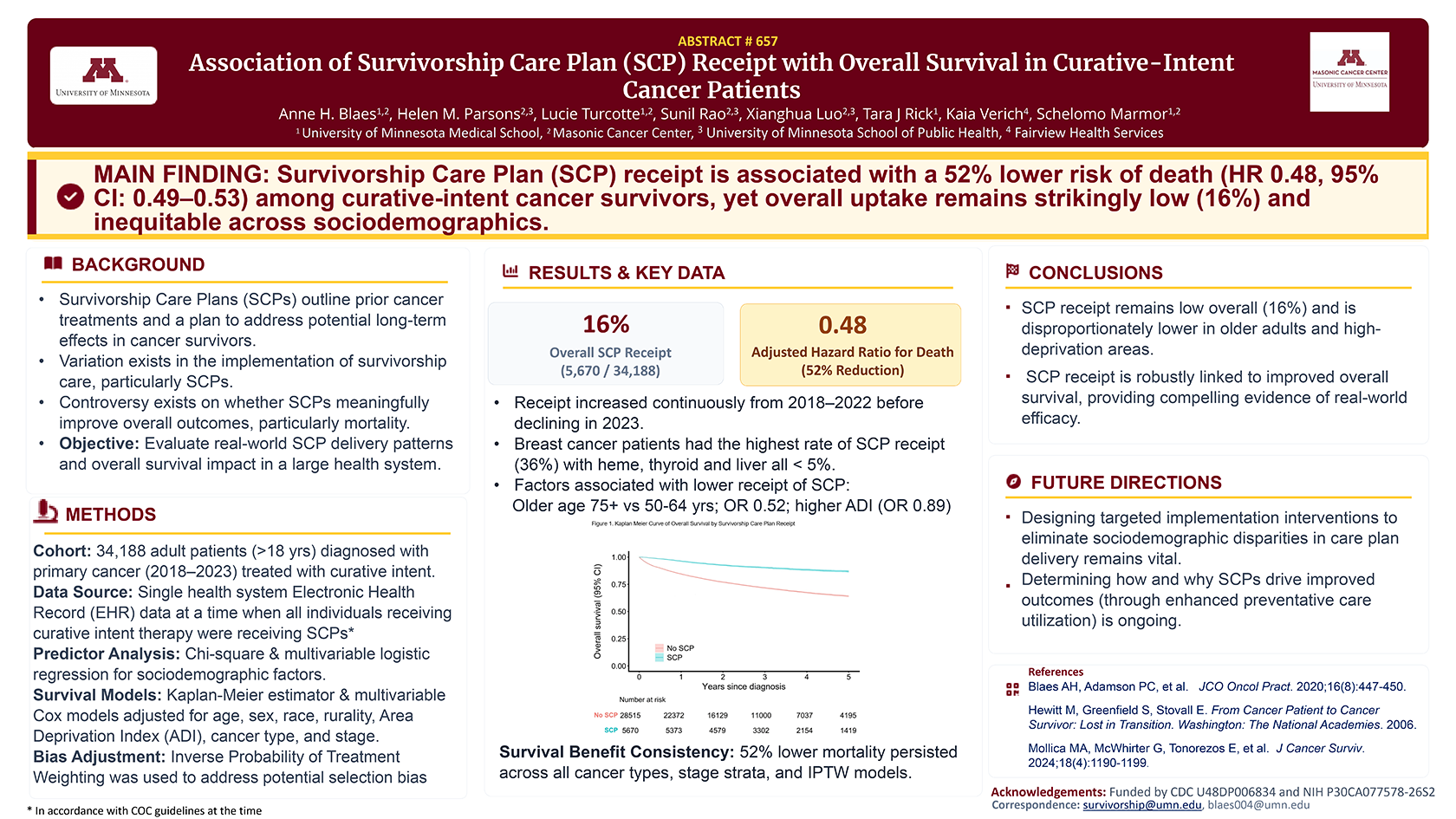
The poster presented by Dr. Blaes’s team at the ASCO Quality Care Symposium. Click image to expand.
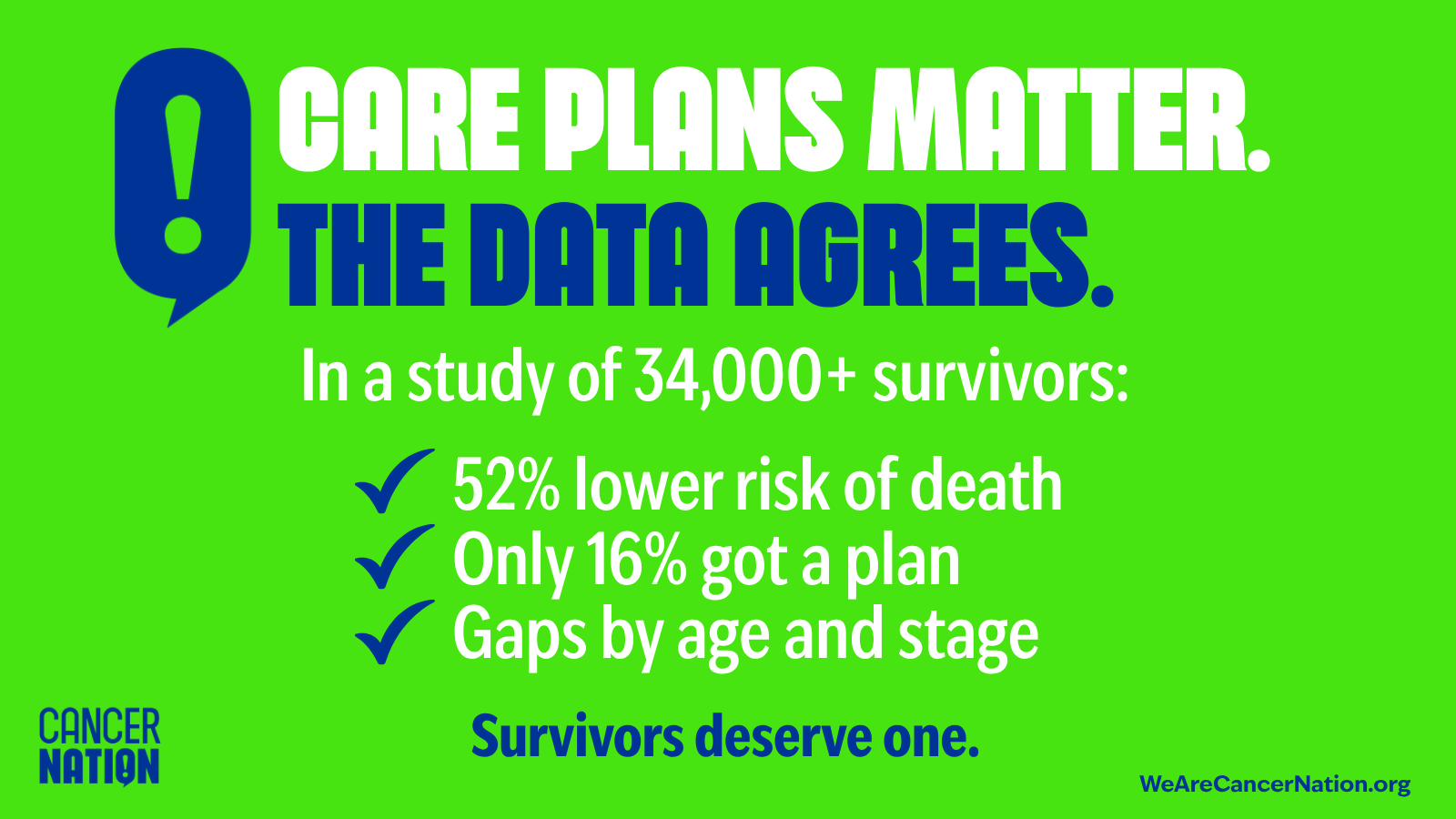
Survivors who received a care plan had a 52% lower risk of death than survivors who did not. The researchers accounted for age, sex, race, rurality, neighborhood disadvantage, cancer type, and stage. The result held across cancer types, stage groups, and nearly every age group, and again when they used a statistical method designed to reduce selection bias.
When we spoke with Dr. Blaes, she told us the team ran multiple sensitivity analyses to check whether stage at diagnosis or other factors explained the difference. The results held up. The researchers expected to see some benefit from care plans. The size of the benefit astounded them.
The study shows a strong association. On its own, it cannot prove the plan itself extends life, and Dr. Blaes has acknowledged that “it has never been clear if SCPs actually improve outcomes for patients.” The next question is why survivors with plans live longer. Are they coming back to clinic for follow-up? Staying connected with primary care? Getting recommended screenings? Dr. Blaes told us answering those questions is the team’s work over the next year.
Dr. Blaes also pointed us to a study of childhood cancer survivors with similar results, published this year in the Journal of the National Cancer Institute (JNCI). Researchers at Emory University and Children’s Healthcare of Atlanta followed 3,366 survivors diagnosed at age 21 or younger. Those who received a care plan at their first survivorship visit had a 38% lower risk of death. Read the PubMed summary.
For survivors, the takeaway is already clear. A care plan is part of quality cancer care, and every survivor should leave treatment with one.
If this were a new drug, everyone would be talking about it
A survival benefit is the holy grail of cancer research. When a new therapy shows one, it makes headlines, moves quickly through review, and changes practice. A 52% lower risk of death would put any new drug at the center of the conversation. This result came from survivorship care: a written plan and the follow-up it sets in motion. It deserves the same urgency.
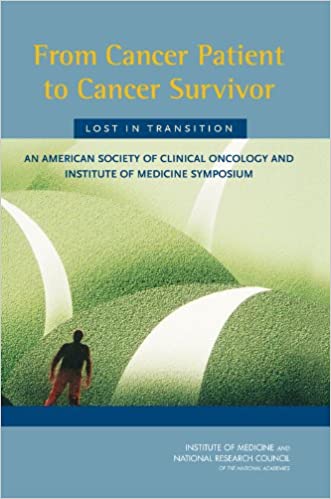 We have been making the case for care plans for two decades. In 2006, the National Academies report “From Cancer Patient to Cancer Survivor: Lost in Transition,” co-edited by our former CEO Ellen Stovall, called for every survivor to leave treatment with one. Read an executive summary here. Since then, we have heard the same objections: plans take too much time, no one pays for them, and there is no proof they change outcomes. In 2019, the Commission on Cancer dropped care plans as an accreditation requirement, in part because of that lack of evidence. Survivors kept asking for them anyway, because they know what it means to finish treatment without a map.
The proof is arriving. The health care system needs to catch up.
The plan exists. Most survivors still don’t get one.
Here is the part that should make every health system and policymaker uncomfortable: only 16% of survivors in the study received a care plan. And the gaps fell along predictable lines.
- Breast cancer survivors had the highest rate, at 36%. Survivors of blood cancers, thyroid cancer, and liver cancer were each below 5%.
- Survivors 75 and older were about half as likely to receive a plan as survivors ages 50 to 64.
- Survivors with stage IV cancer were less likely to receive a plan than survivors with stage I or II.
- Survivors living in more disadvantaged neighborhoods were less likely to receive one.
- After rising from 2018 to 2022, the rate of care plans fell in 2023.
The survivors who may need coordinated follow-up the most are the least likely to get it. That’s a design flaw, and it can be fixed.
What survivors are telling us
These findings echo what we hear from survivors directly. In the Cancer Nation 2025 Survivorship Survey, conducted with Edge Research, only 36% of survivors said they received a survivorship care plan, down from 43% the year before. Survivors who had a plan were significantly more confident managing their health, side effects, and mental wellbeing after treatment.

Click image to expand.
Different studies. Different methods. The same message: survivorship care planning is one of the clearest, most practical ways to improve life after treatment, and too many of us are going without it.
Why we’re not backing down on this policy fight
 Survivorship Care Plans are one of Cancer Nation’s three policy priorities, alongside Whole Person Cancer Care and Financial Protections. We define a survivor as anyone from the moment of diagnosis for the balance of life, including caregivers. A plan is how the health care system honors that definition once active treatment ends.
Care planning takes time, trained staff, and real coordination between oncology and primary care. When that work isn’t paid for or measured, it doesn’t happen consistently, and survivors fall through the cracks. That’s why we support the Lainie Jones Comprehensive Cancer Survivorship Act (H.R. 8839 / S. 5052). This bipartisan bill would, among other priorities, establish Medicare coverage of care planning and coordination services and create an alternative payment model for quality survivorship care.
What you can do
- Survivors: Ask your care team for a survivorship care plan. Ask for your treatment summary, your follow-up schedule, and who leads your care. Share it with your primary care provider.
- Caregivers: You are part of the care team. You can ask, too.
- Health care professionals: Make care plans standard, and look hard at who is being left out.
- Everyone: Tell Congress that every survivor deserves a plan. Learn more about the Lainie Jones Comprehensive Cancer Survivorship Act here.
More Resources:
- Use our Cancer Survivorship Checklist to help you prepare for your appointments.
- Find tools to help you create and use a care plan in our care planning resources.
We need a cure for care. A plan is where it starts.
# # #
Sources: Blaes AH, Parsons HM, et al. Abstract 657, 2026 ASCO Quality Care Symposium, as reported in ASCO Daily News, October 12, 2026. Ji X, Castellino SM, et al. J Natl Cancer Inst. 2026;118(1):85-93. Cancer Nation 2025 Survivorship Survey, conducted with Edge Research.