Survivorship Survey
Clinician Perspective

Clinician Perspective
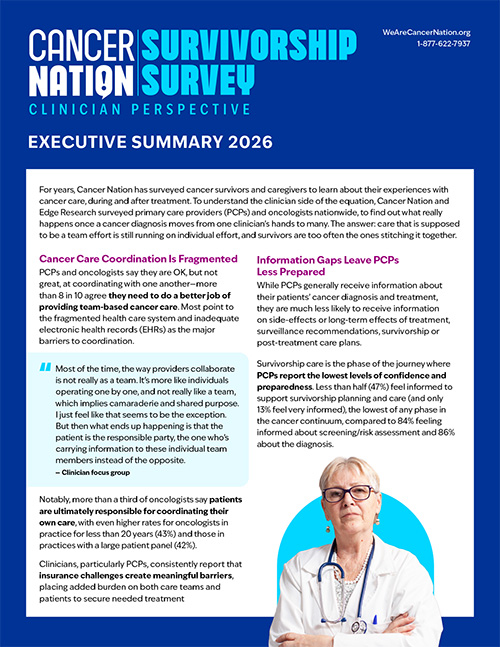
For years, Cancer Nation has conducted a Survivorship Survey of cancer survivors and caregivers to learn about their experiences with cancer care, during and after treatment. This year, we wanted to hear the other side of the story: what clinicians see as the barriers to delivering coordinated, whole-person care.
Cancer Nation worked with Edge Research to survey 306 primary care providers (PCPs) and 302 oncologists nationwide to find out what really happens once a cancer diagnosis moves from one clinician’s hands to many. The answer: care that is supposed to be team-based is still running on individual effort, and survivors are too often the ones stitching it all together.
Our findings reveal a system where care coordination is fragmented, survivorship planning lags behind every other phase of the cancer care continuum, and post-treatment care still has no clear owner.
Topic areas we explored in this survey of clinicians include:
On September 12, Cancer Nation hosted a web briefing to release the results of the survey. In the recording below, Cancer Nation CEO Shelley Fuld Nasso and Pam Loeb and Mariel Molina of Edge Research take a deep dive into the data, and discuss what the findings mean for policy, practice, and the 18 million+ people living with, through, and beyond cancer.
Briefing Topics
00:00 Intro, Survey Objectives
03:23 Methodology & Who Responded
04:39 Key Takeaways
06:18 Communication and Care Coordination
10:45 PCP Information & Confidence Gaps
13:47 How Clinicians Communicate with Each Other
14:32 Patient’s Role in Coordination
17:17 Insurance Challenges
18:00 Managing Side Effects
21:05 Post-Treatment Care Responsibility
23:10 Topics Discussed Post-Treatment
26:02 Clinician Views on Survivorship Care
27:37 Survivorship Care Plans (SCPs)
31:27 SCP Effectiveness
36:07 AI in Cancer Care: How It’s Used & How Often?
38:56 Clinical Trial Recommendation Data
41:09 Q&A Start, Clarifying Methodology Questions
46:47 How do we make SCPs standard?
48:04 Survey Respondents’ Clinical Settings
50:22 More About Clinical Trial Questions
The briefing recording can also be watched on YouTube.
The detailed findings slide deck of the Clinician Perspective survey data contains more data than is featured in the briefing. Download the Detailed Findings here »
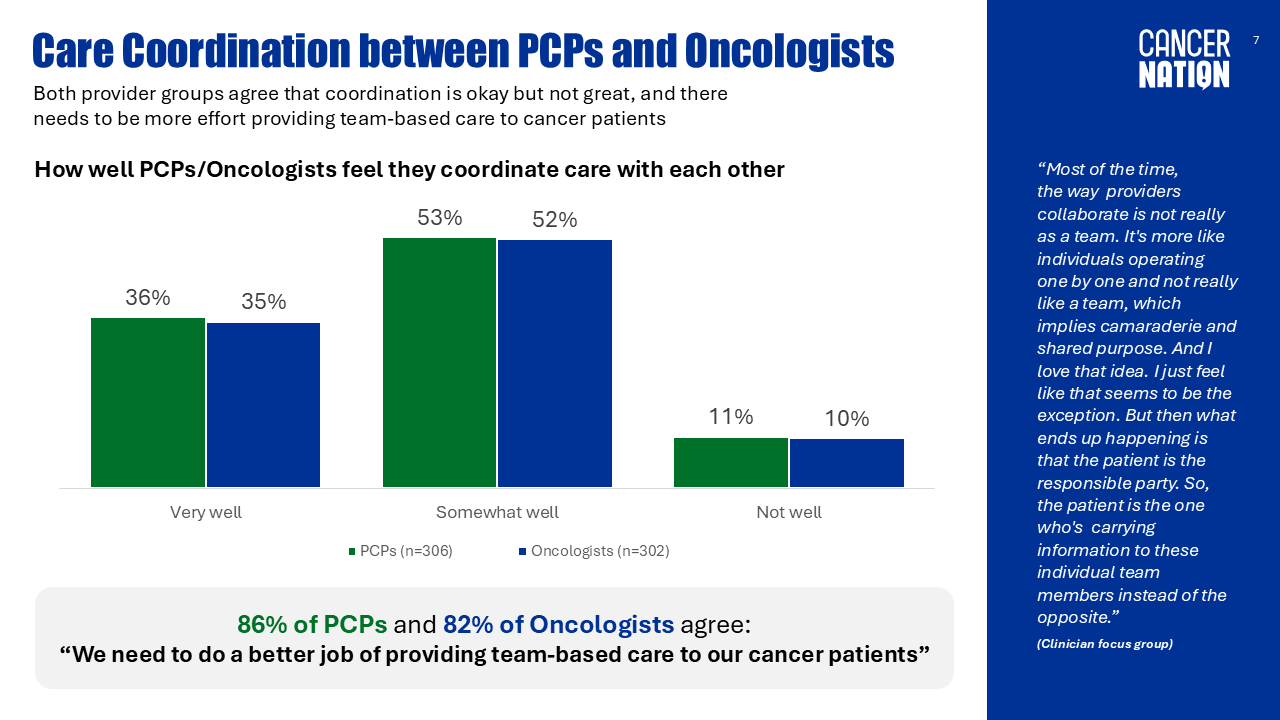 PCPs and oncologists say they are OK, but not great, at coordinating with one another—more than 8 in 10 agree they need to do a better job of providing team-based cancer care. Most point to the fragmented health care system and inadequate electronic health records (EHRs) as the major barriers to coordination.
Notably, more than a third of oncologists say patients are ultimately responsible for coordinating their own care, with even higher rates for oncologists in practice for less than 20 years (43%) and those in practices with a large patient panel (42%).
Most of the time, the way providers collaborate is not really as a team. It’s more like individuals operating one by one, and not really like a team, which implies camaraderie and shared purpose. I just feel like that seems to be the exception. But then what ends up happening is that the patient is the responsible party, the one who’s carrying information to these individual team members instead of the opposite.
— Clinician focus group
Clinicians, particularly PCPs, consistently report that insurance challenges create meaningful barriers, placing added burden on both care teams and patients to secure needed treatment.
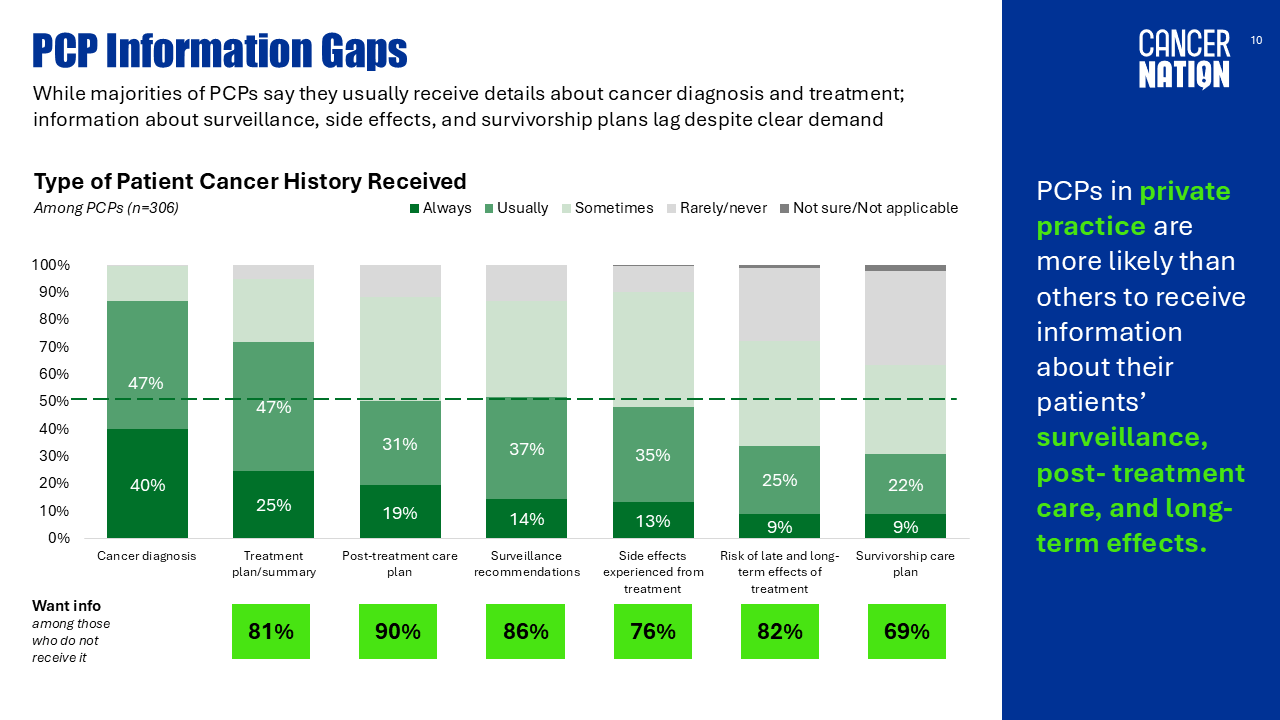 While PCPs generally receive information about their patients’ cancer diagnosis and treatment, they are much less likely to receive information on side-effects or long-term effects of treatment, surveillance recommendations, survivorship or post-treatment care plans.
Survivorship care is the phase of the journey where PCPs report the lowest levels of confidence and preparedness. Less than half (47%) feel informed to support survivorship planning and care (and only 13% feel very informed), the lowest of any phase in the cancer continuum, compared to 84% feeling informed about screening/risk assessment and 86% about the diagnosis.
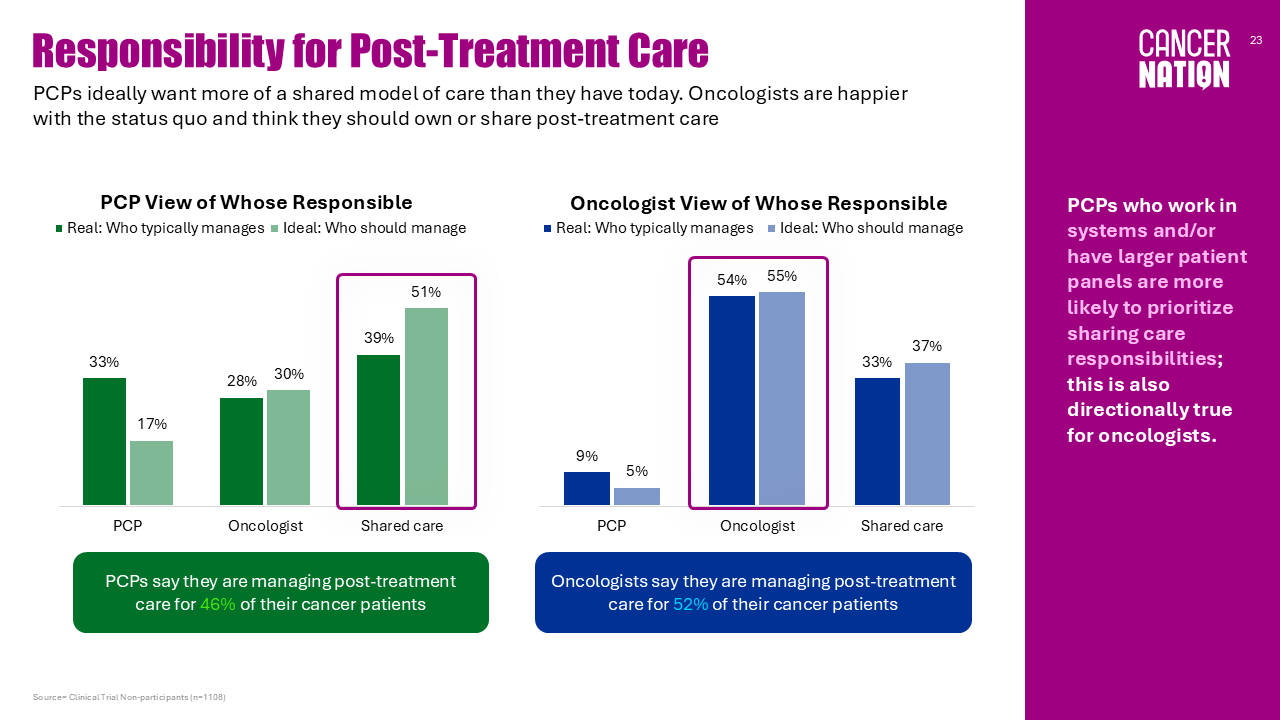 Both clinician groups largely agree that oncologists should lead surveillance and management of treatment-related effects.
However, there is less alignment around responsibility for patients’ quality-of-life and psychosocial concerns, suggesting that many aspects of post-treatment care exist in a gray area.
PCPs want more of a shared-care model than they have today, while oncologists are happy with the status quo and think they should own or share post-treatment care.
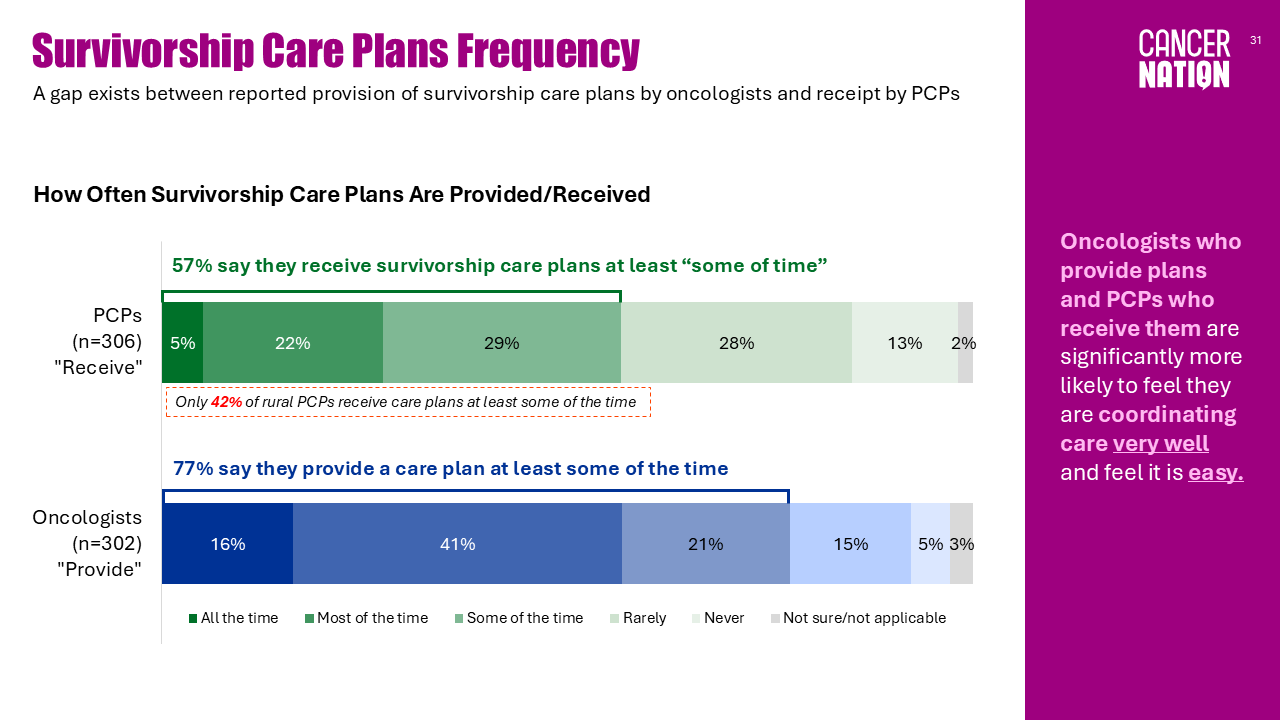 PCPs who receive Survivorship Care Plans (SCPs) and oncologists who provide them report stronger care coordination and communication. That said, there is a 20-point gap between the percentage of oncologists who say they provide these plans (77%) vs. the PCPs who say they receive them (57%). Notably, PCPs who practice in rural areas are much less likely to say they receive survivorship care plans at least some of the time (42%).
Few of these clinicians view SCPs as transformative: only about 1 in 5 PCPs and oncologists rate them as “very effective” overall, and some (23% of oncologists) are skeptical about their ability to improve patient outcomes.
 This perspective differs from what survivors report. Most survivors do not feel prepared in most aspects of managing their care post-treatment, but survivors who have a plan are significantly more confident managing their health, side effects, and mental wellbeing after treatment.
Existing plans are perceived to be heavily focused on clinical follow-up, with less emphasis on mental health, sexual health, community resources, and other broader survivorship needs.
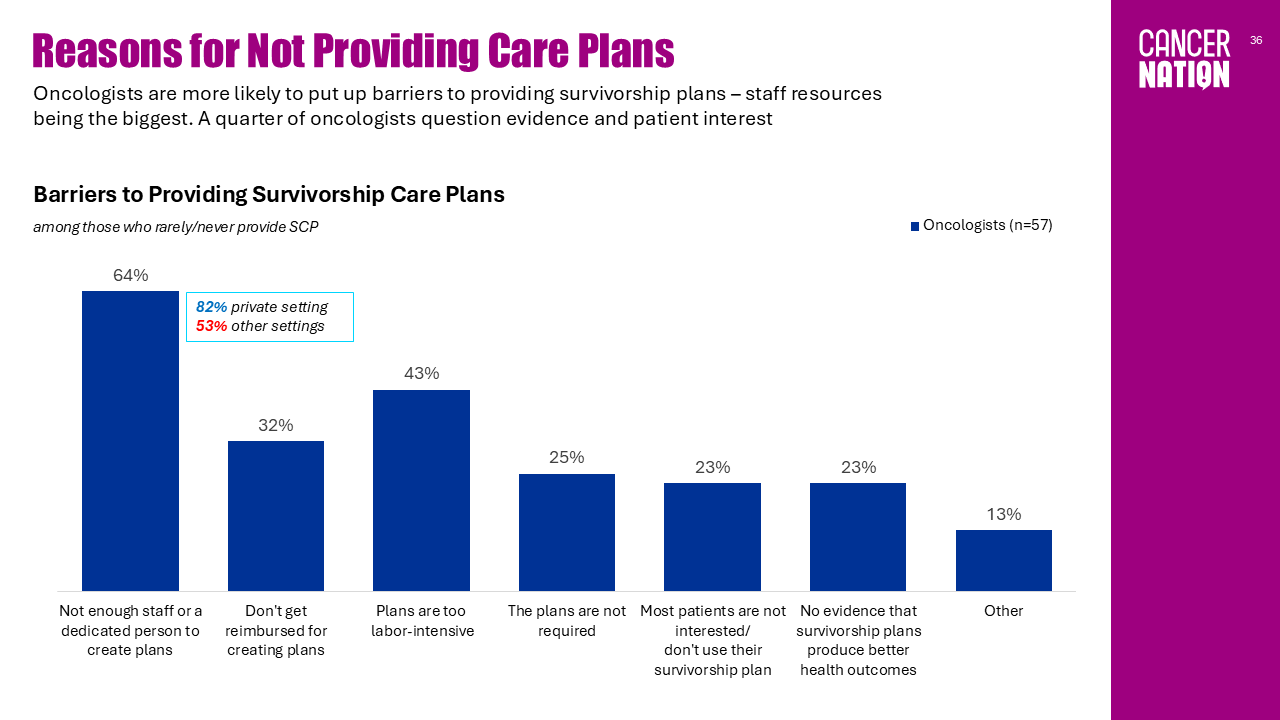
Oncologists who do not provide survivorship care plans say the biggest barrier is insufficient staffing or a dedicated person to create plans (64% overall, and 82% of oncologists in private practice).
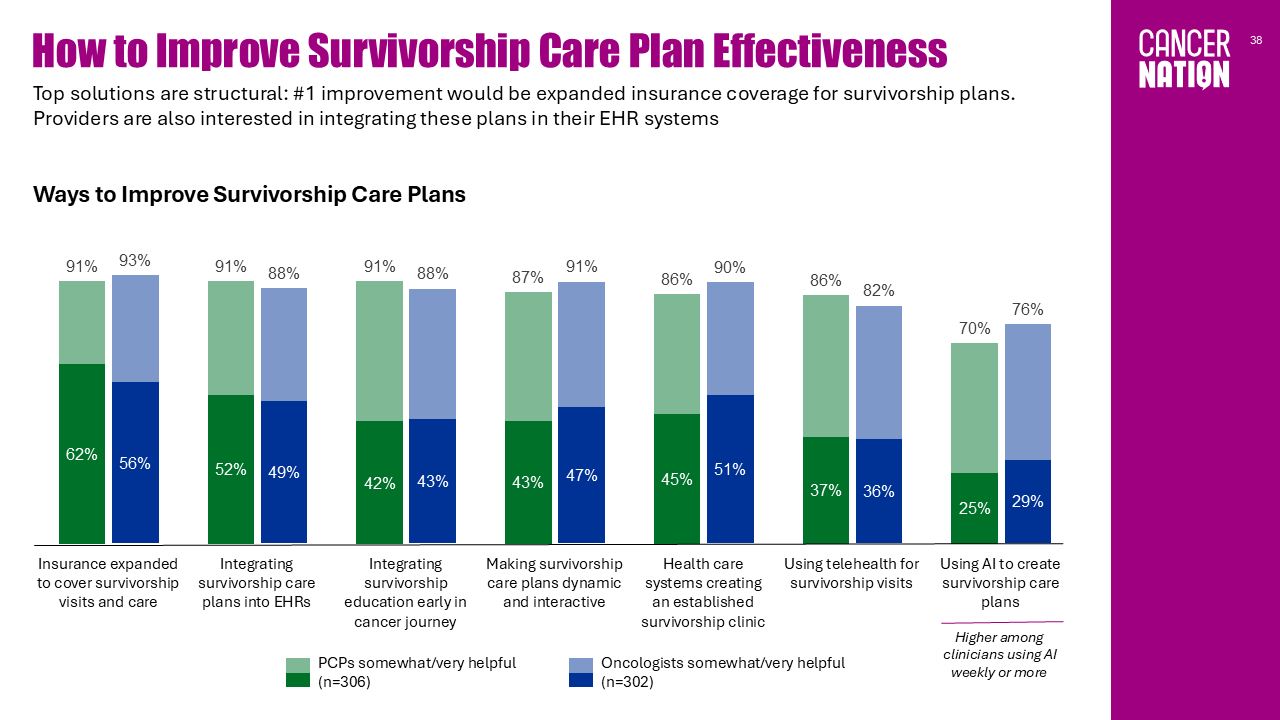 Expanded insurance coverage for survivorship visits, EHR integration of care plans, earlier survivorship education, and dedicated survivorship clinics topped the list of changes clinicians believe would improve post-treatment care.
PCPs and oncologists cite ongoing needs for additional training, education, time, and resources to deliver effective survivorship care.
Across every finding—coordination, information gaps, and post-treatment care—one thing is clear: clinicians are trying, systems are failing, and survivors are caught in between.
We need a Cure for Care—care where every clinician is working from the same plan, not just the survivor.
We are Cancer Nation. And we are here to be heard.
The Survivorship Survey: Clinician Perspective Detailed Findings contains much more information, including data on:
Download the Detailed Findings (PDF) »
Download this Executive Summary (PDF) »
Be the first to hear about cancer policy and survivorship issues! Subscribe and receive the twice-monthly Cancer Nation News, invites to webinars and events, and more.


Founder
Northeast Regional Cancer Institute
“Perhaps one of the most impactful collaborations in Dr. Brereton’s extraordinary career remains his early work and long friendship with Ellen Stovall. Through him, and in turn through the thousands of lives he has touched, Ellen’s work continues, and her mission lives on.”
—Karen M. Saunders
President, Northeast Regional Cancer Institute