
• Link to Facebook
  • Link to X
  • Link to Youtube
  • Link to Instagram
  • Link to LinkedIn
  • Link to Rss this site
  • Store
  • Donate
Cancer Nation (Formerly NCCS)
  • About
        • About Us

        • Cancer Nation is the oldest cancer survivor-led non-profit organization in America. We advocate for quality cancer care for all touched by cancer.

        • About Cancer Nation

        • Our Mission
        • What is Advocacy?Learn about the different types of cancer advocacy, from personal advocacy to public interest advocacy.
        • Our HistoryRead how Cancer Nation’s leaders coined the term “cancer survivor,” and established the nation’s first survivor-led non-profit organization.
        • Our Team
        • Financial Information
        • Employment
        • Contact Us
        • Support Our Mission

        • Make A GiftSupport our mission of quality cancer care for all with a gift to Cancer Nation.
        • The 1986 ClubMake a monthly commitment to support Cancer Nation, empower cancer survivors, and advance public policy.
        • Fundraise for Cancer Nation
        • Ways to GiveLearn about other ways you can contribute to Cancer Nation such as planned giving, employer matches, shopping online, and more.
        • Partnerships
  • News
    • Cancer Nation News Blog
    • Advocate SpotlightEach month, Cancer Nation highlights a cancer survivorship advocate, sharing their story and the work they do in their communities.
    • Policy CommentsRead Cancer Nation’s comments to Congress, HHS, and other federal policymakers in Washington, DC on proposed rules and legislation.
    • Issue StatementsRead Cancer Nation statements on pressing issues and developments in Washington affecting cancer survivors and their families.
    • Newsletter: Cancer Nation News
  • Policy
        • Policy

        • Public policy is government action, in the form of legislation, regulation, funding, and other actions. Public policy affects people with cancer and the cancer care system in many ways.

        • Our Policy Priorities

        • Quality Cancer CareQuality cancer care is essential for patients. Learn how Cancer Nation and others define quality.
        • Access to CareCancer Nation believes cancer care and clinical trials should be affordable and accessible to everyone.
        • Health EquityThe cancer experience is not the same for everyone. Cancer Nation works on policy efforts to reduce disparities in outcomes.
        • Current Issues

        • Protecting Access to Medicaid for Cancer Survivors
        • Comprehensive Cancer Survivorship Act (CCSA)The CCSA is a large comprehensive bill introduced in Congress that aims to improve quality of care in all stages of a diagnosis.
        • Cancer Care Planning and Communications Act (CCPCA)CCPCA is a bill that would provide a billable Medicare service code for cancer care planning.
        • DIEP Flap AccessCancer Nation advocates for protection of access to DIEP Flap Breast Reconstruction Surgery for all breast cancer survivors.
        • Policy CommentsRead Cancer Nation’s comments to Congress, HHS, and other federal policymakers in Washington, DC on proposed rules and legislation.
        • Issue StatementsRead Cancer Nation statements on pressing issues and developments in Washington affecting cancer survivors and their families.
        • Quality Measurement Research
  • Get Involved
        • Get Involved

        • Whether you’re new to cancer advocacy or already have experience as an advocate, there are numerous ways you can get involved with Cancer Nation.

        • Join Cancer Nation

        • Cancer Nation AdvocatesA program that brings together individuals who care about cancer care to learn how policy shapes our health care system—and how we can improve it together.
        • Cancer Nation Leadership AcademyEmerging leaders improving cancer care in their communities.
        • Cancer Nation Corporate Council
        • Advocacy OpportunitiesThis page provides a list of upcoming events, webinars, conferences, and advocacy campaigns from Cancer Nation and other leading cancer organizations.
        • Connect with Us

        • Subscribe to Cancer Nation Updates
        • Follow Cancer Nation on Social Media
        • Survivor Stories
        • Cancerversary
        • Support Cancer Nation

        • Make A Gift
        • Fundraise for Cancer Nation
        • Ways to Give
        • The 1986 Club
  • Survivorship Survey
        • Cancer Nation Survivorship Survey

        • Cancer Nation conducts an annual Cancer Nation Survivorship Survey, in partnership with Edge Research, to explore the cancer patient and survivor journey. This study captures a range of perspectives to better understand how Cancer Nation can support its mission to advocate for quality cancer care for all.

        • Surveys by Year

        • Clinician Perspective (2026)
        • 2025 Survivorship Survey
        • 2024 Survivorship Survey
        • 2023 Survivorship SurveyThe 2023 Survey explored the caregiver experience for the first time, and features new data on the effect of cancer treatment on employment.
        • 2022 Survivorship SurveyThe 2022 Survey found significant disparities in cancer care that impact people of color, young adults, women, and those with metastatic cancer, at higher rates.
        • 2021 Survivorship SurveyThe 2021 Survey demonstrated that when patients receive quality care, have excellent support, and have financial resources, they are more likely to have positive outcomes.
        • 2020 Survivorship SurveyIn the 2020 Survey, survivors reported that their care team is not helpful at addressing some common side effects of their cancer such as fatigue, anxiety, and depression.
  • Survivorship Checklist
        • Cancer Survivorship Checklist

        • The Cancer Survivorship Checklist is designed to be a simple, straightforward tool patients and caregivers can use as a guide for information critical to their care wherever they are on the cancer care continuum.

        • Start Your Cancer Survivorship Checklist
        • Survivorship Checklist Guide for Clinicians
        • Resources for Cancer Survivors

        • Survivorship ResourcesA collection of resources that provide information about navigating the cancer journey.
        • Cancer RehabilitationA supportive health care service that helps improve a person’s functioning during and after cancer treatment.
        • Integrative OncologyA field that combines traditional cancer treatments with therapies that support a person’s natural healing ability.
        • Palliative CareSpecialized medical care for people living with a serious illness that provides relief from the symptoms and stress to improve their quality of life.
        • Cognitive HealingA resource to support cognitive functioning after cancer treatment. Includes cognitive training strategies and tools for both adults and children.
  • Resources
        • Resources

        • Cancer Nation provides a wide variety of resources for patients, caregivers, and health care professionals.

        • Resources for Survivors and Caregivers

        • Health Insurance & Open Enrollment
        • Cancer Survival ToolboxA free, award-winning audio program created by leading cancer organizations to help people better meet & understand the challenges of their illness.
        • Ina® The Intelligent Nutrition Assistant
        • Telehealth
        • Care Planning for Cancer Survivors
        • Remaining Hopeful
        • Self Advocacy
        • Talking With Your Doctor
        • Taking Charge of Your Care
        • Order Our Resources
        • Resources for Health Care Professionals

        • Tools For Care Providers
        • Telehealth Project
        • Survivorship Champions Webinars
        • Survivorship Checklist Guide for Clinicians
  • Events
    • 40th Anniversary Gala
    • 2026 Cancer Nation Summit
    • 2026 Cancer Nation Virtual Summit
    • Ellen L. Stovall Award
      • 2026 Winners
      • Awardees
      • Nominations
      • Committees
    • Igniting Hope Awards Reception
    • Cancer Nation Webinars
    • Cancer Nation Policy Roundtable
      • Fall 2025
      • Spring 2025
      • Fall 2024
      • Spring 2024
      • Fall 2023
      • Spring 2023
  • 0

NCCS is now Cancer Nation. Find out more about our next chapter.    Join Us

a photo of a medical professional and patient discussing a care plan

New Research Links Survivorship Care Plans to Longer Lives. So Why Do So Few Survivors Get One?

October 22, 2026/in Cancer Nation News, Cancer News Care Coordination, Care Planning, Quality Cancer Care, Survivorship Care Cancer Nation News

We have said it for years: when treatment ends, survivors need a plan. A written record of the care we received. A roadmap for what comes next. A clear answer to the question so many of us ask as we walk out of our last appointment: who do I call now?

New research presented at the 2026 ASCO Quality Care Symposium gives that demand new weight.

What the study found

Researchers at the University of Minnesota, led by Anne H. Blaes, MD, MS, studied 34,188 adults diagnosed with cancer between 2018 and 2023 and treated with curative intent at a single health system. They used electronic health records to confirm who received a survivorship care plan.
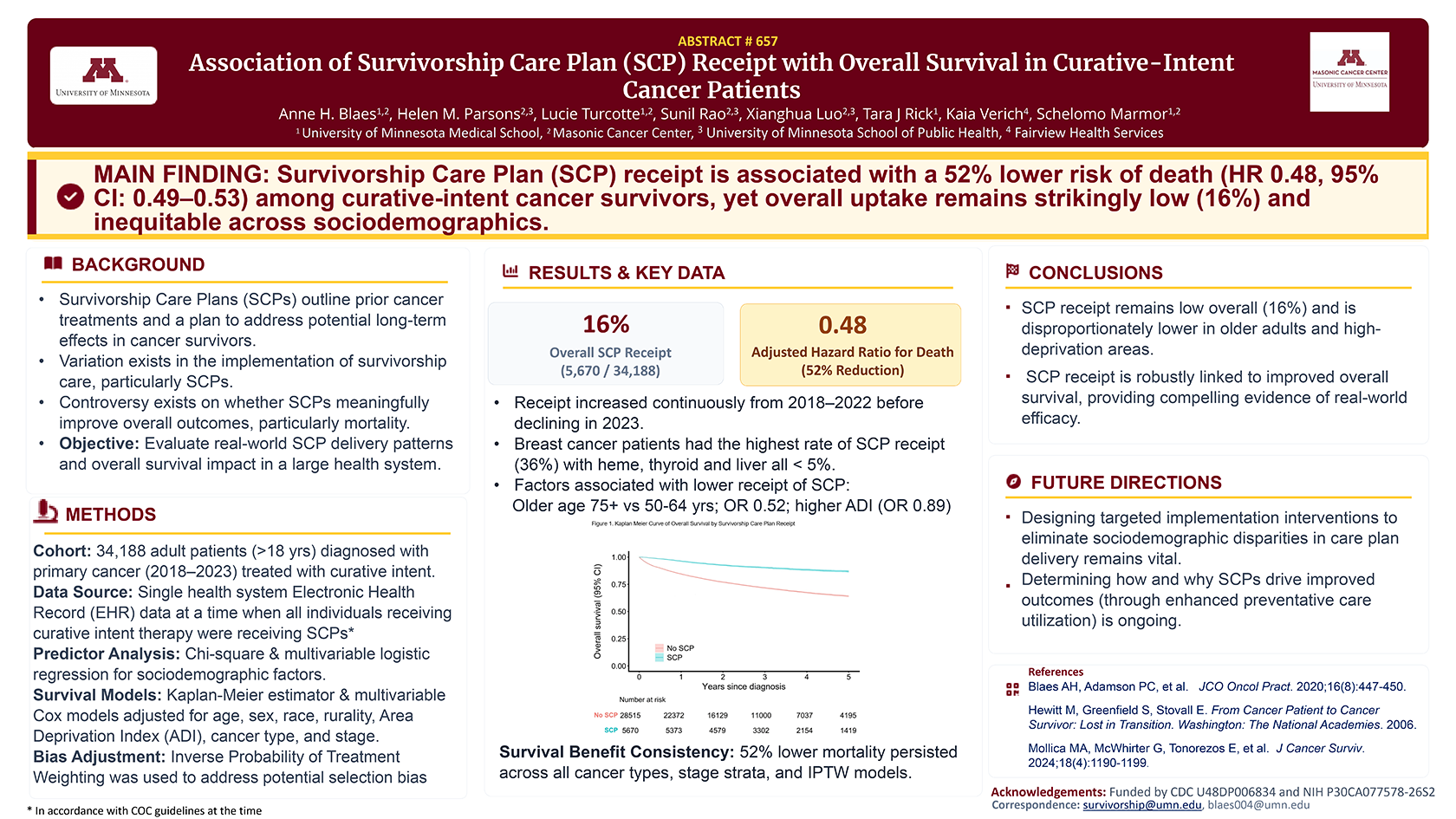
Poster from the 2026 ASCO QLTY conference by Anne Blaes, et al, titled "Association of Survivorship Care Plan (SCP) Receipt with Overall Survival in Curative-Intent Cancer Patients

The poster presented by Dr. Blaes’s team at the ASCO Quality Care Symposium. Click image to expand.

Survivors who received a care plan had a 52% lower risk of death than survivors who did not. The researchers accounted for age, sex, race, rurality, neighborhood disadvantage, cancer type, and stage. The result held across cancer types, stage groups, and nearly every age group, and again when they used a statistical method designed to reduce selection bias.

When we spoke with Dr. Blaes, she told us the team ran multiple sensitivity analyses to check whether stage at diagnosis or other factors explained the difference. The results held up. The researchers expected to see some benefit from care plans. The size of the benefit astounded them.

The study shows a strong association. On its own, it cannot prove the plan itself extends life, and Dr. Blaes has acknowledged that “it has never been clear if SCPs actually improve outcomes for patients.” The next question is why survivors with plans live longer. Are they coming back to clinic for follow-up? Staying connected with primary care? Getting recommended screenings? Dr. Blaes told us answering those questions is the team’s work over the next year.

Dr. Blaes also pointed us to a study of childhood cancer survivors with similar results, published this year in the Journal of the National Cancer Institute (JNCI). Researchers at Emory University and Children’s Healthcare of Atlanta followed 3,366 survivors diagnosed at age 21 or younger. Those who received a care plan at their first survivorship visit had a 38% lower risk of death. Read the PubMed summary.

For survivors, the takeaway is already clear. A care plan is part of quality cancer care, and every survivor should leave treatment with one.

If this were a new drug, everyone would be talking about it

A survival benefit is the holy grail of cancer research. When a new therapy shows one, it makes headlines, moves quickly through review, and changes practice. A 52% lower risk of death would put any new drug at the center of the conversation. This result came from survivorship care: a written plan and the follow-up it sets in motion. It deserves the same urgency.
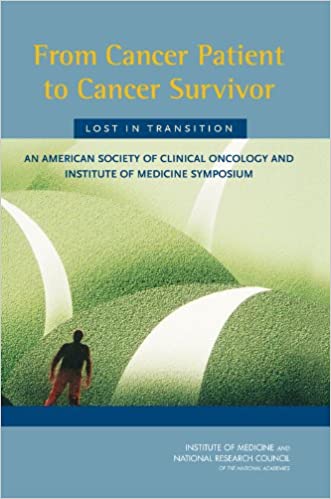
Lost in TransitionWe have been making the case for care plans for two decades. In 2006, the National Academies report “From Cancer Patient to Cancer Survivor: Lost in Transition,” co-edited by our former CEO Ellen Stovall, called for every survivor to leave treatment with one. Read an executive summary here. Since then, we have heard the same objections: plans take too much time, no one pays for them, and there is no proof they change outcomes. In 2019, the Commission on Cancer dropped care plans as an accreditation requirement, in part because of that lack of evidence. Survivors kept asking for them anyway, because they know what it means to finish treatment without a map.

The proof is arriving. The health care system needs to catch up.

The plan exists. Most survivors still don’t get one.

Here is the part that should make every health system and policymaker uncomfortable: only 16% of survivors in the study received a care plan. And the gaps fell along predictable lines.

  • Breast cancer survivors had the highest rate, at 36%. Survivors of blood cancers, thyroid cancer, and liver cancer were each below 5%.
  • Survivors 75 and older were about half as likely to receive a plan as survivors ages 50 to 64.
  • Survivors with stage IV cancer were less likely to receive a plan than survivors with stage I or II.
  • Survivors living in more disadvantaged neighborhoods were less likely to receive one.
  • After rising from 2018 to 2022, the rate of care plans fell in 2023.

The survivors who may need coordinated follow-up the most are the least likely to get it. That’s a design flaw, and it can be fixed.

What survivors are telling us

These findings echo what we hear from survivors directly. In the Cancer Nation 2025 Survivorship Survey, conducted with Edge Research, only 36% of survivors said they received a survivorship care plan, down from 43% the year before. Survivors who had a plan were significantly more confident managing their health, side effects, and mental wellbeing after treatment.

Survey 2025 Slide 48 Survivorship Care Plans

Click image to expand.

Different studies. Different methods. The same message: survivorship care planning is one of the clearest, most practical ways to improve life after treatment, and too many of us are going without it.

Why we’re not backing down on this policy fight
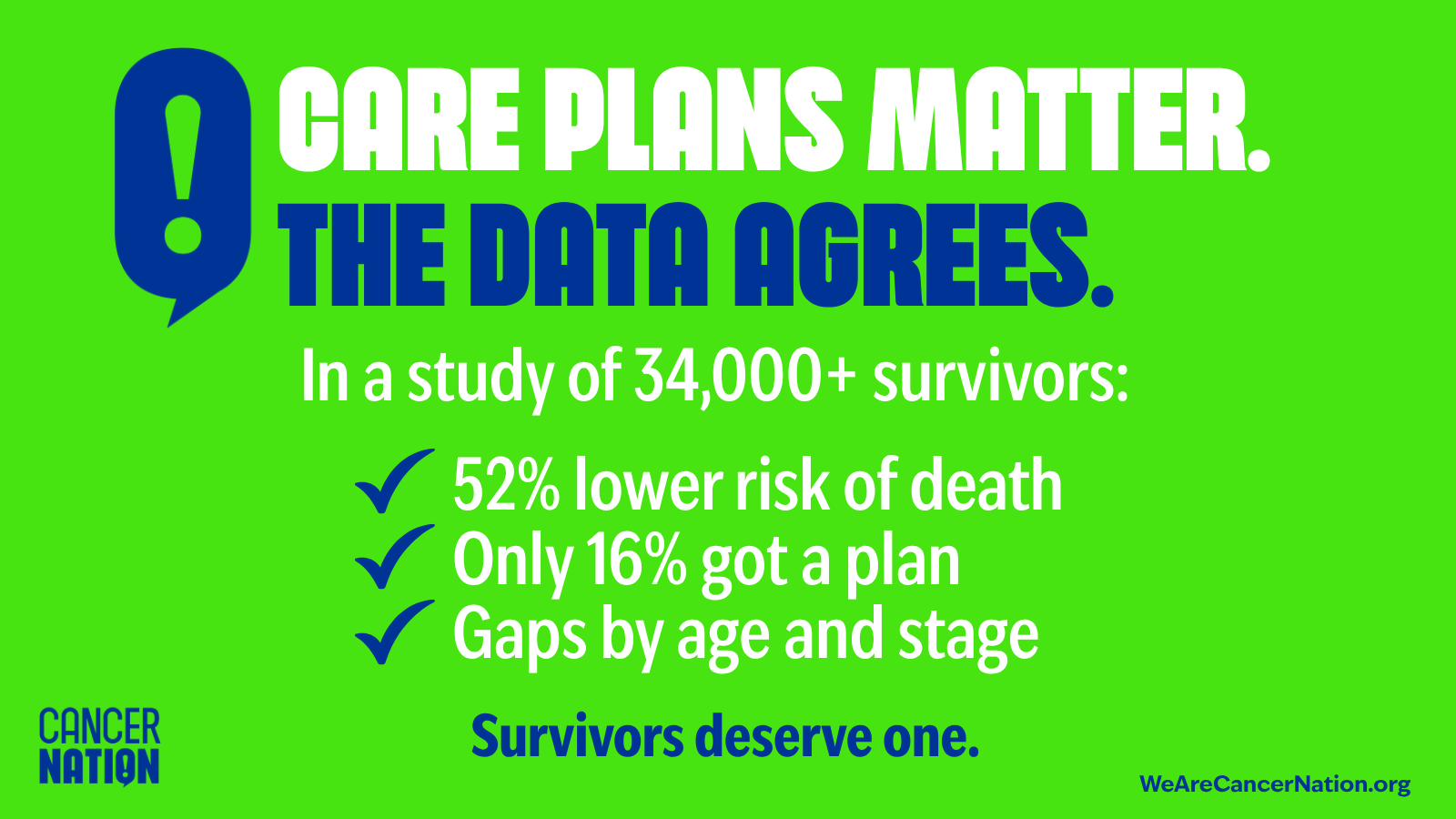
graphic with bright green background and text over it. Text reads CARE PLANS MATTER. THE DATA AGREES. In a study of 34,000+ survivors: 52% lower risk of death | Only 16% get a plan. | Gaps by age and stage. | Survivors deserve one.Survivorship Care Plans are one of Cancer Nation’s three policy priorities, alongside Whole Person Cancer Care and Financial Protections. We define a survivor as anyone from the moment of diagnosis for the balance of life, including caregivers. A plan is how the health care system honors that definition once active treatment ends.

Care planning takes time, trained staff, and real coordination between oncology and primary care. When that work isn’t paid for or measured, it doesn’t happen consistently, and survivors fall through the cracks. That’s why we support the Lainie Jones Comprehensive Cancer Survivorship Act (H.R. 8839 / S. 5052). This bipartisan bill would, among other priorities, establish Medicare coverage of care planning and coordination services and create an alternative payment model for quality survivorship care.

What you can do

  • Survivors: Ask your care team for a survivorship care plan. Ask for your treatment summary, your follow-up schedule, and who leads your care. Share it with your primary care provider.
  • Caregivers: You are part of the care team. You can ask, too.
  • Health care professionals: Make care plans standard, and look hard at who is being left out.
  • Everyone: Tell Congress that every survivor deserves a plan. Learn more about the Lainie Jones Comprehensive Cancer Survivorship Act here.

More Resources:

  • Use our Cancer Survivorship Checklist to help you prepare for your appointments.
  • Find tools to help you create and use a care plan in our care planning resources.

We need a cure for care. A plan is where it starts.

# # #

Sources: Blaes AH, Parsons HM, et al. Abstract 657, 2026 ASCO Quality Care Symposium, as reported in ASCO Daily News, October 12, 2026. Ji X, Castellino SM, et al. J Natl Cancer Inst. 2026;118(1):85-93. Cancer Nation 2025 Survivorship Survey, conducted with Edge Research.

Tags: Cancer Survivorship, care planning, ccsa, research
Share this entry
  • Share on Facebook
  • Share on X
  • Share on WhatsApp
  • Share on LinkedIn
https://canceradvocacy.org/wp-content/uploads/doctor-patient-care-plan.jpg 675 1200 NCCS Staff https://canceradvocacy.org/wp-content/uploads/CancerNation_Logo_40Yrs_Stacked_TwoColor-scaled.png NCCS Staff2026-10-22 12:38:192026-10-22 13:35:52New Research Links Survivorship Care Plans to Longer Lives. So Why Do So Few Survivors Get One?

Latest News

a photo of a medical professional and patient discussing a care plan

New Research Links Survivorship Care Plans to Longer Lives. So Why Do So Few Survivors Get One?

October 22, 2026
We have said it for years: when treatment ends, survivors need a plan. A written record of the care we received. A roadmap for what…
Read more
https://canceradvocacy.org/wp-content/uploads/doctor-patient-care-plan.jpg 675 1200 NCCS Staff https://canceradvocacy.org/wp-content/uploads/CancerNation_Logo_40Yrs_Stacked_TwoColor-scaled.png NCCS Staff2026-10-22 12:38:192026-10-22 13:35:52New Research Links Survivorship Care Plans to Longer Lives. So Why Do So Few Survivors Get One?

Ringing the Bell Is Not the Finish Line: Desa-Rhea Jefferson on What Cancer Survivors Need Next

September 24, 2026
Desa-Rhea Jefferson survived liver cancer at 3 and thyroid cancer as an adult. She says ringing the bell is a starting point, not a finish line. Read more.
Read more
https://canceradvocacy.org/wp-content/uploads/Desa-Rhea-Jefferson_-Advocate-Spotlight-Blog-Banner.png 600 1200 Elleni https://canceradvocacy.org/wp-content/uploads/CancerNation_Logo_40Yrs_Stacked_TwoColor-scaled.png Elleni2026-09-24 11:10:172026-09-24 11:10:17Ringing the Bell Is Not the Finish Line: Desa-Rhea Jefferson on What Cancer Survivors Need Next
Image with Orchid background. Text reads: Cancer Nation Stovall Awards | 2026 Honorees | Patient Advocate Award - Erin Geddis Cummings, MSW, LCSW | Health Care Professional Award - Bradley J. Zebrack, PHD, MSW, MPH

Cancer Nation to Recognize Erin Cummings and Bradley J. Zebrack with 2026 Ellen L. Stovall Award

September 17, 2026
Cancer Nation is proud to announce the recipients of the 2026 Ellen L. Stovall Award for Innovation in Patient-Centered Cancer Care: …
Read more
https://canceradvocacy.org/wp-content/uploads/Stovall-Award-Honorees-2026-web-featured.jpg 675 1200 NCCS Staff https://canceradvocacy.org/wp-content/uploads/CancerNation_Logo_40Yrs_Stacked_TwoColor-scaled.png NCCS Staff2026-09-17 13:55:462026-09-22 13:46:42Cancer Nation to Recognize Erin Cummings and Bradley J. Zebrack with 2026 Ellen L. Stovall Award

Take Action

Link to: Survivorship Champions

Get Involved in Research

Cancer Nation conducts an annual Survivorship Survey to explore how patients and survivors are living with, through, and beyond cancer. This study captures a range of perspectives to better understand how Cancer Nation can support its mission to advocate for quality cancer care for all.

Learn More and Request Data Here »
Link to: Cancer Nation Advocates

Join Cancer Nation Advocates

Cancer Nation Advocates is a a program that brings together individuals who care about cancer care to learn how policy shapes our health care system—and how we can improve it together

Learn More and Join »
Link to: Survivor Stories

Share Your Story

Cancer Nation represents the millions of Americans who share a common experience – living with, through and beyond a cancer diagnosis. By sharing your story of how you have been touched by cancer, you are supporting the national cancer survivorship movement.

Share Your Story »
  • About
    • Our Mission
    • What is Advocacy?
    • Our History
    • Our Team
    • Financial Information
    • Employment
    • Contact Us
    • Make A Gift
    • The 1986 Club
    • Fundraise for Cancer Nation
    • Ways to Give
    • Partnerships
  • News
    • Cancer Nation News Blog
    • Advocate Spotlight
    • Policy Comments
    • Issue Statements
    • Newsletter: Cancer Nation News
  • Policy
    • Quality Cancer Care
    • Access to Care
    • Health Equity
    • Protecting Access to Medicaid for Cancer Survivors
    • Comprehensive Cancer Survivorship Act (CCSA)
    • Cancer Care Planning and Communications Act (CCPCA)
    • DIEP Flap Access
    • Policy Comments
    • Issue Statements
    • Quality Measurement Research
  • Get Involved
    • Cancer Nation Advocates
    • Cancer Nation Leadership Academy
    • Cancer Nation Corporate Council
    • Advocacy Opportunities
    • Subscribe to Cancer Nation Updates
    • Follow Cancer Nation on Social Media
    • Survivor Stories
    • Cancerversary
    • Make A Gift
    • The 1986 Club
    • Fundraise for Cancer Nation
    • Ways to Give
  • Survivorship Survey
    • Clinician Perspective (2026)
    • 2025 Survivorship Survey
    • 2024 Survivorship Survey
    • 2023 Survivorship Survey
    • 2022 Survivorship Survey
    • 2021 Survivorship Survey
    • 2020 Survivorship Survey
  • Survivorship Checklist
    • Start Your Cancer Survivorship Checklist
    • Survivorship Resources
    • Cancer Rehabilitation
    • Integrative Oncology
    • Palliative Care
    • Cognitive Healing
    • Survivorship Checklist Guide for Clinicians
  • Resources
    • Cancer Survival Toolbox
    • Telehealth
    • Health Insurance & Open Enrollment
    • Care Planning for Cancer Survivors
    • Ina® The Intelligent Nutrition Assistant
    • Remaining Hopeful
    • Self Advocacy
    • Talking With Your Doctor
    • Taking Charge of Your Care
    • Order Our Resources
    • Tools For Care Providers
    • Telehealth Project
    • Survivorship Champions Webinars
    • Survivorship Checklist Guide for Clinicians
  • Events
    • 40th Anniversary Gala
    • 2026 Cancer Nation Summit
    • 2026 Cancer Nation Virtual Summit
    • Ellen L. Stovall Award
      • 2026 Winners
      • Awardees
      • Nominations
      • Committees
    • Igniting Hope Awards Reception
    • Cancer Nation Webinars
    • Cancer Nation Policy Roundtable
      • Fall 2025
      • Spring 2025
      • Fall 2024
      • Spring 2024
      • Fall 2023
      • Spring 2023
  • Search
  • Cart

Charity Navigator Four-Star Rating

Cancer Nation Logo

Cancer Nation
8455 Colesville Road  |  Suite 1025 | Silver Spring, MD 20910
info@canceradvocacy.org | (877) NCCS-YES
Privacy Policy  |  Terms and Conditions

Copyright © 1995-2026 by Cancer Nation. National Coalition for Cancer Survivorship, NCCS, Cancer Survival Toolbox, Cancerversary, and related Logos are registered in the United States as trademarks of Cancer Nation (formerly the National Coalition for Cancer Survivorship).

Link to: Ringing the Bell Is Not the Finish Line: Desa-Rhea Jefferson on What Cancer Survivors Need Next Link to: Ringing the Bell Is Not the Finish Line: Desa-Rhea Jefferson on What Cancer Survivors Need Next Ringing the Bell Is Not the Finish Line: Desa-Rhea Jefferson on What Cancer...
Scroll to top Scroll to top Scroll to top

This website uses cookies to improve user experience. By continuing to use this site, you agree to our Privacy Policy. Learn More.

Get Updates From Cancer Nation

Be the first to hear about cancer policy and survivorship issues! Subscribe and receive the twice-monthly Cancer Nation News, invites to webinars and events, and more.

  • This field is for validation purposes and should be left unchanged.

Connect With Us

Twitter     Facebook     Instagram     LinkedIn     YouTube

Harmar Brereton, MD

Founder
Northeast Regional Cancer Institute


“Perhaps one of the most impactful collaborations in Dr. Brereton’s extraordinary career remains his early work and long friendship with Ellen Stovall. Through him, and in turn through the thousands of lives he has touched, Ellen’s work continues, and her mission lives on.”

—Karen M. Saunders
President, Northeast Regional Cancer Institute