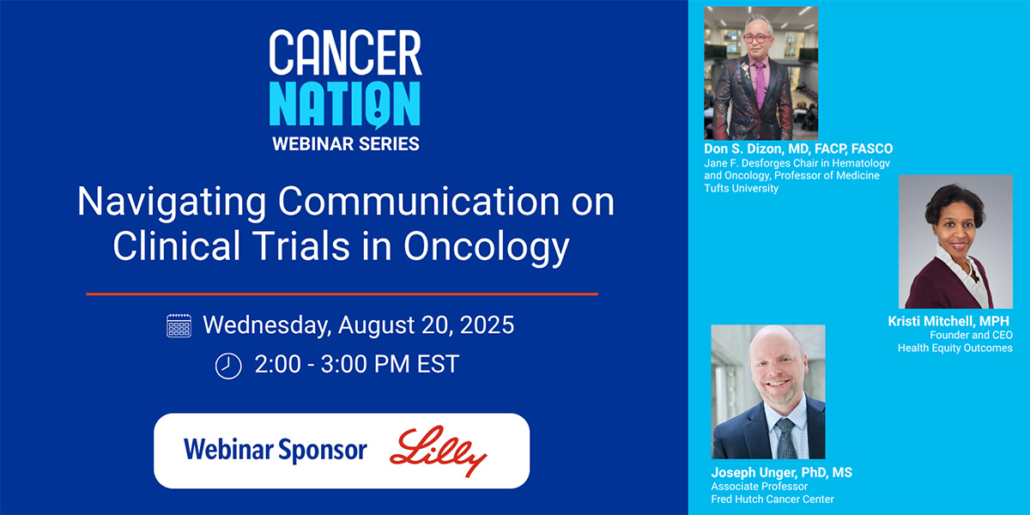
Webinar: Navigating Communication on Clinical Trials in Oncology
Clinical trials are the cornerstone of advancing cancer treatment, offering patients cutting-edge therapies while contributing to critical research. However, effective communication between patients and oncologists is essential to ensure understanding, participation, and optimal outcomes.
In Cancer Nation’s 2024 State of Survivorship Survey, participation in clinical trials remains consistent, with key drivers being the doctor’s recommendation (51%) and the prospect of access to new treatments (28%). Among patients who did not participate in clinical trials, 74% of patients said that they were not asked, which remains the largest barrier. Patients also cited concerns about side effects, treatment protocols, and location as secondary barriers, with these concerns being more prominent among younger patients and patients of color.


This webinar discusses the role of communication in clinical trial participation. Viewers will gain insight into how communication can influence trial participation, improve patient understanding, and address concerns such as eligibility, side effects, and informed consent. Viewers will also learn about resources related to clinical trial participation available to oncology professionals and their patients.
Featured speakers for this presentation:
- Kristi Mitchell, MPH of Health Equity Outcomes
- Don S. Dizon, MD of Tufts University
- Joseph Unger, PhD of Fred Hutch Cancer Center
This webinar is presented by Cancer Nation (formerly the National Coalition for Cancer Survivorship). The webinar is sponsored by Lilly.
Watch the webinar below or here on YouTube.
This webinar is presented by Cancer Nation (formerly the National Coalition for Cancer Survivorship).
Slides and Video Chapters
- 2024 State of Survivorship Survey Data – Read the Detailed Findings, including data on clinical trials.
- Dr. Unger shared a figure about structural barriers in clinical trials from an article he co-authored, “Systematic Review and Meta-Analysis of the Magnitude of Structural, Clinical, and Physician and Patient Barriers to Cancer Clinical Trial Participation.”
- Video Chapters:
00:00 Survivorship Survey Clinical Trial Data
05:02 Kristi Mitchell–Community Engagement
10:15 Don Dizon–How Co-Op Groups Help Participation
19:20 Joseph Unger–Structural Barriers
26:21 How do we address structural barriers?
39:22 Language and Timing to Engage Patients
53:01 Financial Barriers and Issues
About Don S. Dizon, MD, FACP, FASCO
 Don S. Dizon is is the Service Line Chief of Hematology and Oncology at Tufts Medical Center and Professor of Medicine at Tufts University. Nationally, he serves as the Vice Chair of Membership and Accrual at SWOG Cancer Research Network, a member of the National Cancer Institute’s National Clinical Trials Network and as Editor in Chief of CA: A Cancer Journal for Clinicians, the flagship journal of the American Cancer Society. He is a medical oncologist specializing in ovarian, cervical, and uterine cancer, prevention – particularly as it relates to the HPV vaccine, sexuality after cancer for men and women, and professional use of social media. He Among his other roles, he is Chairperson of the Hope Foundation for Cancer Research and sits on the board of The Cancer Network. Dr. Dizon is a founding member of the Collaboration for Outcomes Using Social Media in Oncology and is active on many platforms, including Threads, Instagram, Facebook, and TikTok. Follow him @drdonsdizon.
About Kristi Mitchell, MPH
 Kristi is a health services researcher who leads efforts to enable next generation health care delivery through innovation, value, and consumer engagement across multiple industries, including pharmaceutical/device companies, digital health, government agencies, and community-based organizations. After 11 years, she stepped down as Practice Director, Center for Healthcare Transformation at Avalere Health, a DC-based advisory services firm to launch, Health Equity Outcomes, a nonprofit to empower underserved communities to engage in the research enterprise to reduce racial disparities and advance health equity. Through these efforts, she is dedicated to elevating the role of community-based participatory research as a mechanism to derive real world data that is community-centric. At the same time, she also serves as Founder and Principal at ATLAS CLARITY, LLC an advisory services firm dedicated to improving the health and well-being of populations through patient engagement, strategic partnerships, and innovative data collection.
Kristi is also recognized as a nationally recognized expert in the design and implementation of patient-powered data collection efforts. She currently sits on the MDEpiNet Executive Operations Committee and serves as chair of the National Kidney Foundation KidneyCARE Study Data Use and Publication Committee. Kristi is a member of Women’s Business Leaders in Healthcare, as well as a Founding Member of CHIEF-DC, a private network to support and connect women executives.
A graduate of Brown University (’92) with a A.B. in human biology and public policy, she earned her Masters of Public Health in Epidemiology and Public Health Policy and Administration from the University of Michigan School of Public Health (’94)
About Joseph Unger, PhD
 Dr. Unger is an Associate Professor at the Fred Hutch Cancer Center in Seattle and a Senior Health Services Researcher and Biostatistician with the SWOG Cancer Research Group. He has extensive experience in clinical trial design, health disparities, health outcomes research, quality of life, and patient-reported outcomes. He has been the lead statistician on multiple high-profile randomized clinical trials examining the efficacy of interventions to control symptoms related to cancer and its treatment. Alongside his clinical trial research focus, he is a recognized leader in barriers to clinical trials and disparities in access to clinical trials. He was a key contributor to the American Cancer Society Cancer Action Network’s Landscape Report on barriers to clinical trials. He led an education session at the ASCO Annual Meeting that included a comprehensive exploration of the landscape of barriers to clinical trials for cancer patients. He has published two systematic reviews and meta-analyses about trial barriers that have reoriented the focus on trial barriers away from the patient and towards the system of clinical trial conduct.