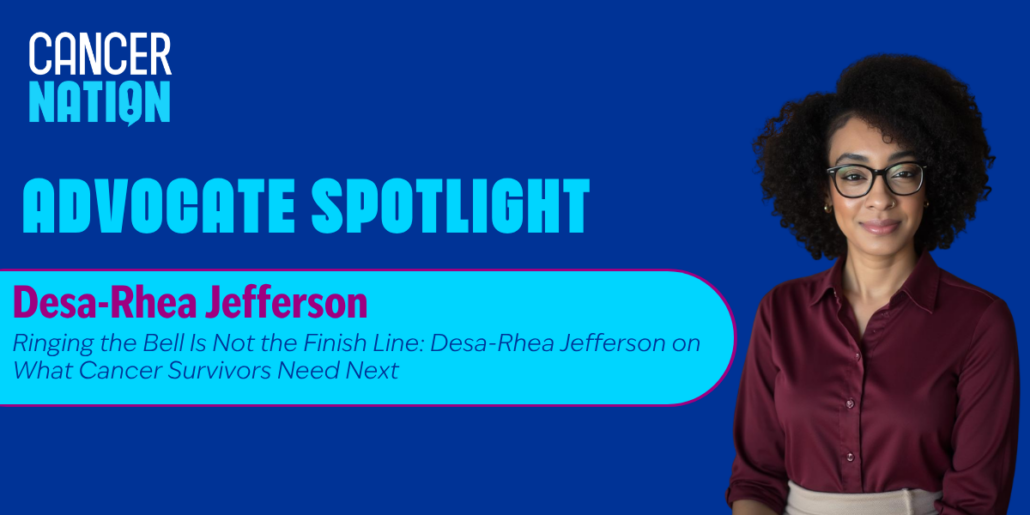
Ringing the Bell Is Not the Finish Line: Desa-Rhea Jefferson on What Cancer Survivors Need Next
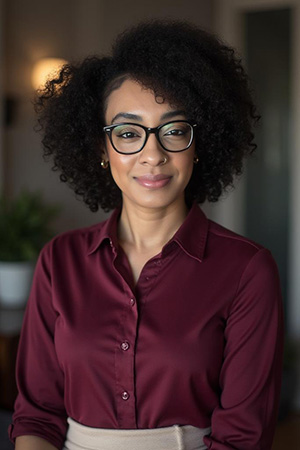 Desa-Rhea Jefferson’s mother, Amaryllis, still keeps a box filled with the well wishes and prayers people sent when her daughter was 3 years old. Desa-Rhea had liver cancer, and her mother had been told she would not survive. She is still here.
Desa-Rhea is a two-time cancer survivor and an oncology data specialist. She was diagnosed with hepatoblastoma in 1991, before she was old enough to remember it. Decades later, as a young adult in graduate school with a young son at home, she was diagnosed with thyroid cancer.
Cancer survivorship has been part of nearly her entire life. For much of that time, she did not have the information, guidance, or support to know what to expect next.
A Childhood Cancer Survivor Who Never Knew Life Before Cancer
Her mother noticed first. Desa-Rhea was unwell, and her stomach was quite enlarged. Hepatoblastoma was considered rare then. Treatment meant removing a portion of her liver, followed by chemotherapy. She was granted a wish through the Make-A-Wish Foundation, and her family went to Disney World.
Desa-Rhea was too young to remember much of that time herself. But one fact has shaped how she understands her life as a survivor.
“I never had the privilege of knowing what life looked like before my diagnosis.”
Her second diagnosis came when she was old enough to understand what was happening — and to be afraid. She was earning her graduate degree, working, and raising her son. She went in and out of the emergency room trying to understand why she kept feeling so unwell. Months passed with fatigue, brain fog, and overall malaise before a provider finally called.
“She took a deep breath and said, Desa-Rhea, I believe you have cancer in your thyroid, and you need to get evaluated right away,” she recalls.
That conversation, she says, will live with her forever.
Treatment felt complicated. There was a partial thyroidectomy, then a complete one. Then radiation therapy, including several days when she could not be around anyone at all. Desa-Rhea remembers being so scared.
Years earlier, when Desa-Rhea was 19, a physician had been able to palpate a nodule in her neck. No one explained to her what that could mean. She believes her thyroid cancer could have been caught much earlier.
From Behind the Screen: How Desa-Rhea Jefferson Became a Cancer Advocate
Professionally, Desa-Rhea works in the cancer registry field as an oncology data specialist, mentoring and handling data collection and quality control for local hospitals and a central registry.
Then she saw a LinkedIn post about Cancer Nation and decided to apply for a scholarship to attend the Cancer Nation Summit. The Summit was her first experience with advocacy. Hill Day was her first time meeting with policymakers.
“This was hands-on, real-time advocacy, and while I was a bit intimidated, I felt prepared by our sessions and just the insight from other attendees,” she says.
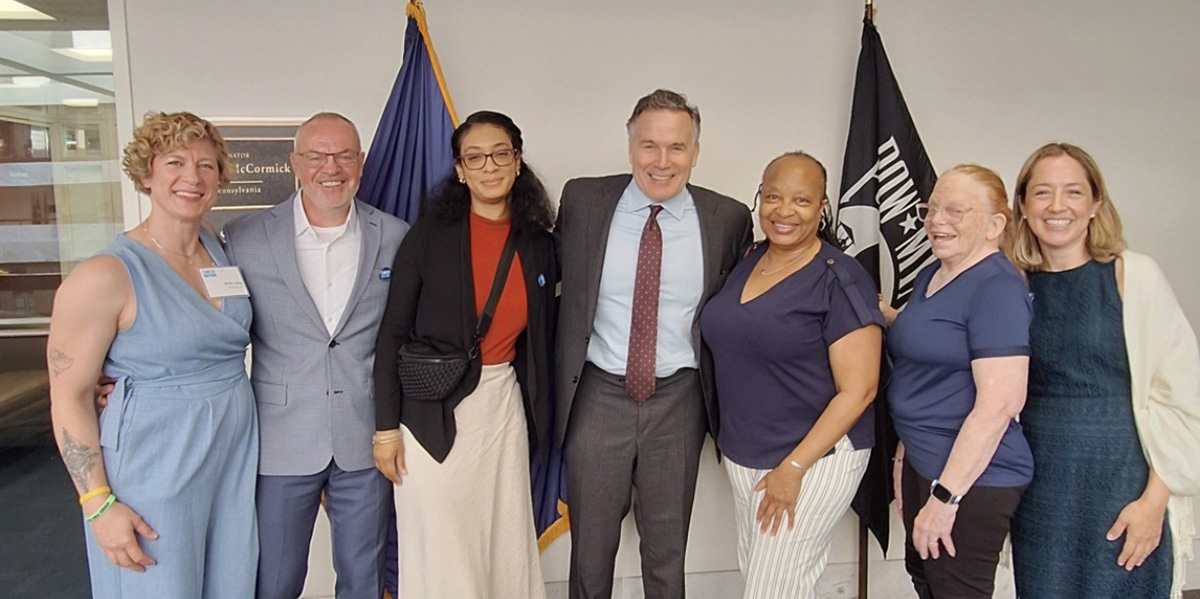
Desa-Rhea and a group of advocates from Pennsylvania met with Rep. Dave McCormick (center) to advocate for the Comprehensive Cancer Survivorship Act.
Everyone she met there, she says, changed something in her. She now has what she calls the advocacy bug.
The experience also showed her that speaking up could lead somewhere. The offices she met with followed through on what they said they would do.
“It made me feel like my voice actually mattered,” she says.
What Cancer Survivors Need After Treatment Ends
Ask Desa-Rhea what stood between her and quality cancer care, and she does not start with insurance. She starts with silence.
As a childhood cancer survivor becoming an adult, she had no navigation, no education about long-term effects, and no structured handoff from pediatric care to adult care. She was left with unanswered questions and no one assigned to answer them.
When the second diagnosis arrived, she again found herself without the guidance she needed. She met with providers, but she cannot recall a single person who sat down with her to explain what to expect. She had questions about the financial impact, taking time away from school, and supporting herself as a young woman who had now experienced cancer twice.
A Survivorship Care Plan is intended to provide survivors with information about the treatment they received, what to watch for, who is responsible for follow-up, and what comes next. Desa-Rhea went through both transitions without that kind of plan.
She also searched on her own for ways to address symptoms she says resonate all too well with childhood cancer survivors. She turned toward eastern medicine and the natural sciences, including talk therapy, sound medicine, homeopathy, acupuncture, food, water, and movement. She is careful about how she frames these approaches: for her, they are not replacements for conventional medicine but complements to it.
“I had to learn through trial and error how important it is to have more than one tool in my resource box,” she says.
She believes people should consider modalities that complement conventional care, survivor or not. Her experience also shows why whole person cancer care matters. Her needs extended beyond treating cancer itself, and she had to seek out much of that additional support on her own.
Her Message to Survivors and to Policymakers
To survivors who are newly diagnosed or newly in survivorship, Desa-Rhea encourages them to celebrate themselves and care for themselves to the best of their ability. “Laugh often,” she says. “Acknowledge that it is hard, but do not stay there. And always advocate for yourself.”
Her message to policymakers focuses on what happens after treatment ends.
“Survivors need fast, reliable access to services,” she says, along with help returning to the workforce, academics, and family life. “Not every survivor finishes treatment with the same physical, mental, emotional, or financial capacity they had going in. Finishing treatment does not mean those needs disappear.”
“Not every life is a straight path,” she says.
Desa-Rhea’s experience is part of why we advocate for Whole Person Cancer Care, Survivorship Care Plans, and Financial Protections. Survivorship begins at diagnosis and continues for the balance of a person’s life. The care and support survivors need must recognize that reality, too.
Want to turn your experience into action, the way Desa-Rhea has?
Desa-Rhea started with a single LinkedIn post and a scholarship application. Learn more about Cancer Nation Advocates and join for free. »
Frequently Asked Questions
What is it like to be a childhood cancer survivor as an adult?
Childhood cancer survivors often reach adulthood carrying late effects from treatment they received before they were old enough to consent to it or remember it. Many, like Desa-Rhea Jefferson, are at elevated risk for a second cancer. The transition from pediatric oncology to adult care is a common gap: young survivors are frequently discharged from pediatric care without a clear handoff, without a record of what they received, and without anyone tracking their long-term risks.
What is a Survivorship Care Plan and who should have one?
A Survivorship Care Plan is a written summary of the cancer treatment a survivor received, along with a schedule for follow-up care, the late effects to watch for, and clear assignment of who is responsible for monitoring what. Every survivor should receive one at the end of active treatment. In practice, most do not. Cancer Nation advocates for Survivorship Care Plans to be a standard, reimbursed part of cancer care rather than an optional extra.
What is Whole Person Cancer Care?
Whole Person Cancer Care means treating the whole survivor, not just the tumor. It includes physical health, mental health, financial stability, employment, education, family life, and the supportive and complementary services that help survivors function day to day. It is one of Cancer Nation’s three policy priorities, alongside Survivorship Care Plans and Financial Protections.
How can cancer survivors get involved in cancer advocacy?
Most advocates start with no policy background at all. Cancer Nation Advocates is a program for people interested in improving cancer care, which prepares survivors and caregivers to speak with legislators, share their experience effectively, and understand the policy landscape. Desa-Rhea Jefferson attended the Cancer Nation Summit on a scholarship, then went to Hill Day for the first time. Learn more about Cancer Nation Advocates and join for free. »
What does Cancer Nation do for cancer survivors?
Cancer Nation, formerly known as National Coalition for Cancer Survivorship (NCCS), advocates for quality cancer care for all people touched by cancer. Founded in 1986, we represent 18 million+ people living with, through, and beyond cancer. We define a survivor as anyone from the point of diagnosis for the balance of their life, including caregivers.