
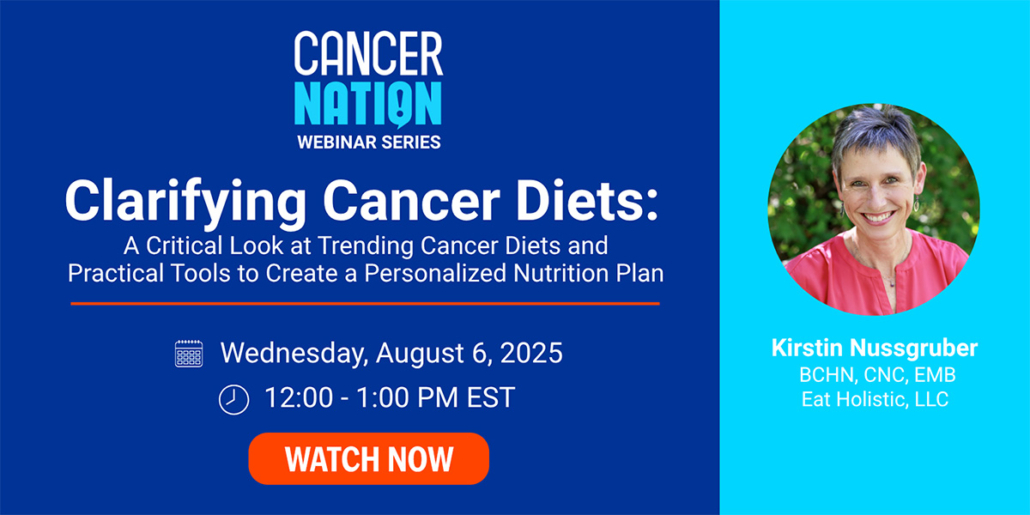
Clarifying Cancer Diets: A Critical Look at Trending Diets & Practical Tools for Nutrition Planning
Cancer survivors often find themselves confronted with trying to navigate through the maze of confusing and contradictory nutritional approaches in cancer care. Cancer diets may concentrate on specific cancer-fighting nutrients, inflammation reduction, overall quality of life, and adequate nourishment to deal with debilitating and lingering treatment side effects.
However, dealing with a cancer survivor’s nutritional needs raises many questions:
– Is there a specific cancer diet?
– Which one is best for you, or for that phase in your cancer journey?
– Can these diets be viewed as trends, or does each have a specific role to play in an increasingly personalized cancer care approach?
In this webinar brought to you by Cancer Nation, cancer nutrition expert and author Kirstin Nussgruber tackles these common questions from a practical, evidence-informed perspective. The presentation takes a critical look at the ketogenic, low-carbohydrate, and plant-based diets, as well as intermittent fasting. Kirstin also discusses carbs, proteins, and fats — what they are, how your body processes them, and when to eat them.
Viewers will walk away with the ability to make informed decisions and obtain practical tools to help them create a personalized nutrition plan best suited to their needs. Kirstin answered many audience questions after the session. Read them below.
Watch the webinar below or here on YouTube. Read Kirstin’s bio below.
This webinar is presented by Cancer Nation (formerly the National Coalition for Cancer Survivorship).
Slides and Video Chapters
- Presentation Slide Deck – Nutrition and Cancer, Kirstin Nussgruber (PDF)
- Video Chapters:
- 00:00 Introduction
02:30 Overview
04:00 Cancer Nutrition Research
07:47 Plant-Based Diets
12:14 Ketogenic Diets
20:23 Low-Carb Diets
25:35 Intermittent Fasting
32:36 Macronutrients–Carbs, Proteins, Fats
50:33 “Fast Food” Tips
55:40 Diet in Personalized Cancer Care
56:13 Monitoring Your Microenvironment
57:16 How can you implement a personal nutrition plan?
58:57 How do you weed out bad cancer diet information online?
- 00:00 Introduction
Your Cancer Nutrition Questions Answered
During the webinar, we received a TON of questions from our audience but we did not have a lot of time to answer them. We collected the questions and are so grateful to Kirstin for answering them after the webinar.
- Does sugar truly feed cancer? Should cancer patients avoid ALL sugar, even though carbs break down into sugar? (We received variations of this question more than any other question.)
This is probably the most misunderstood subject in cancer nutrition, and I am happy to further elaborate on it. You will also find this discussed in my presentation Slides #16-19 and #29-34.
- Do you have to take out sugar in your diet? Also can you use artificial sweeteners?
Refined sugar yes, and you need to understand how your body metabolizes whole foods sugars like honey, maple syrup and coconut sugar, as well as sugars from complex carbohydrates. Please refer to slide #47 “Monitoring your Microenvironment” for a list of diabetic labmarkers that help you understand this, and also see the answer I gave to the previous question “does sugar feed cancer”. There are certain sweeteners that do not raise blood glucose levels. They include stevia leaf extract, monk fruit (also known as Luo Han Guo), erythritol, allulose, xylitol (toxic to dogs!). Cinnamon and vanilla essence are alternate sweetener options too you may not be familiar with, try them. They work!
- So healthy eaters who overconsume SOME food items at one time, might overload the system with sugars and other carbs routinely (e.g. smoothies, juiced vegetables) and encourage tumor growth?
Healthy, fiber-rich foods that lead to balanced blood sugar levels due to their very nature have not been shown to increase cancer risk. Smoothies are a healthy addition to a diet especially when containing proteins (example: protein powders, nut or seed butters, hemp seeds), healthy fats (example: nut or seed butters, avocado, MCT oil) and mainly low glycemic fresh produce (example: berries, cucumbers, celery). Please also refer to my answer to the first question “does sugar feed cancer”.
- You mentioned optimal quantities of carbs & proteins; what about mono/poly fats?
This depends on your personal ideal daily calorie intake. When you cap and control calories from both carbohydrates and protein, there is a gap left to fulfil your own daily caloric requirement and this will be met by fats. Both monounsaturated as well as polyunsaturated fats are considered healthy fat options and you can strike a balance between the to. Examples of these fats are provided in my slides #40-41 and #44.
- How can a patient work with their health care team to develop and implement a safe and effective personalized nutrition plan?
I answered this at the end of the webinar. In short: Some cancer centers have registered dieticians you can work with (covered by some health insurances, please verify), or you can work with private practitioners like myself (not covered by health insurance). If you wish to work with a private practitioner, please make sure they are qualified in oncology nutrition. We study the same oncology nutrition books as dieticians do. It is unfortunately not considered standard of care that every cancer patient automatically receives nutrition support, you have to initiate this support yourself and make it known that you will add this to your health plan.
- How might a patient’s cultural or personal food preferences be incorporated into a cancer diet plan?
I consider this is a vital component when implementing a successful nutrition plan, making sure the personal preferences and “comfort foods” are firstly considered, secondly met, but thirdly and most importantly, adequately evaluated against the nutritional requirements and daily habitual eating patterns of the person. Are they contributing to an imbalance and inflammation? If yes, they need to be adapted for health reasons to optimize the inner terrain.
- Is there a meal plan included in this [presentation] to get one started? Is the plant-based diet different from the Ketogenic diet? Are they combined?
Meal Plans are highly personalized, the aim of this presentation was to offer a review of certain trending cancer diets and to teach you what to look for when assessing the type and qualities of macronutrients (carbohydrates, proteins and fats) in particular with reference to the diets I focused on in my presentation. Yes, a plant-based diet is different from a ketogenic diet and I address this in detail in my presentation.
- What resources are available to help patients understand and navigate the complex information surrounding cancer diets?
A very valid question, there is a need for easy access to trustworthy and evidence-informed nutrition information to help sort out the confusion surrounding cancer and nutrition. Holding this webinar at Cancer Nation is meant to be such a resource. Working with a nutritionist or dietician qualified in oncology nutrition is another resource. Please also refer to the very last question I answered at the end of the webinar as I address how you can trust online information sources there.
- How do we access this service and how do we find out if our insurance covers this type of service?
If you mean by “this service” how you could work with someone like myself, you are welcome to go to my website www.kirstinscancercare.com” and email me via my contacts page. I am board-certified in holistic nutrition, insurance companies do not accept my services. Cancer Centers that have registered dieticians on staff can bill insurance.
- As a breast cancer survivor, should I be following a plant-based diet? I was given no direction, advice or recommendations following my treatment.
We are much better served when embracing a personalized approach to our health, and that includes assessing which nutrition direction is optimal for us. There is ample evidence that a healthy, plant-based whole foods approach reduces cancer risk, and the studies I mentioned show this, but it would negate a personalized approach if we claim that all breast cancer survivors should follow an only plant-based approach. It depends, and we each need to find out what is ideal for us. I have vegan clients that have been diagnosed with cancer. Being vegan in prior years did not prevent their diagnosis.
- I’m seeing a lot of different advice about what should and shouldn’t be eaten at all and whether you need to eat an anti-inflammatory diet. I’m not sure what foods are anti-inflammatory. My sense is that a mediterranean diet is best. Can you confirm?
Cutting out highly processed foods and sweetened beverages leaves real whole foods with ingredients that require you to cook from scratch, and drinking beverages that have no added sugars, are the basis for an anti-inflammatory way of eating. Many healthy foods can cause inflammation and this requires a deep dive into possible causes and contributing factors to digestive issues, and a personalized approach to reversing these food reactions. The mediterranean diet is a good example of a healthy way of eating that incorporates many anti-inflammatory foods. There is no single diet that can be called “the best” for everyone.
- Are there foods (post treatment) we should avoid or incorporate in our diets based on the type of breast cancer? (For example, estrogen positive, triple negative, etc…)
I am not aware of any robust nutrition research that specifies the impact of foods based on the type of breast cancer. The same food recommendations I discuss apply for all types of cancers, as it focuses on nourishing and strengthening the inner terrain, or microenvironment to help harness the body’s own ability to regulate its metabolism properly.
- What are some myths about cancer diets? Is there a specific cancer diet that can be followed?
My presentation offers you a good overview of some cancer diets using evidence-informed information from robust, peer-reviewed studies, many of them meta-analyses where lots of existing studies are compared to each other and summary conclusions are presented. I also offer guidance on how to personalize your own nutrition approach as we are all unique and there is no single “best” diet suitable for everyone.
- How about the questions of coffee and caffeine?
Coffee and caffeine intake needs to be evaluated per person. It is a stimulant and has an acidic effect on the body when metabolized that can affect mineral absorption.
- Is (a) excessive adipose tissue (b) prior to a diagnosis of ‘obesity’ (c) tumorogenic?
Excess body fat, whether or not it has the tag “obese” attached, has been shown to increase cancer risk in a plethora of studies.
- What do you say about the ‘fever’ on taking Creatine monohydrate?
This is a nutritional supplement, mainly used for improving muscle health, that requires a personal evaluation before being added to a protocol. As with all supplements, I never recommend “just taking it” because it has now become trendy and keeps on popping up in social media feeds. Do you need it? Can your body metabolize it? Is it a quality product that has been third party tested? Who is selling it and are they private-labeling it? Is it just a smart marketing trap meant to generate business for someone who has no clue about your personal health history?
- How does intermittent fasting affect blood pressure?
The relationship is complex and highly individualized. A recent meta analysis (many existing studies were reviewed and compared, considered the most robust research data) in 2022 showed a potential effect on lowering systolic blood pressure, but not diastolic blood pressure.
- Do beans and plant-based protein powders (and vegetables) contribute any risks for cancers, (or during treatment)?
Beans and legumes are whole plant-based foods and are a healthy, fiber-rich plant-based protein addition to a diet. Plant-based protein powders as well, but quality does matter as “cheaper” versions can add a significant amount of additives that can lead to potential digestive reactions and sensitivities that can fuel inflammation. Look at the ingredients list, how long is it, do you recognize them and what is the primary source of protein used, and where is it harvested.
- Are those with thyroid issues contraindicated when using Keto diet?
The thyroid controls overall metabolism, growth and development of many organ systems and body functions. A Ketogenic diet, when done properly, changes the body’s energy metabolism from using glucose to using ketones as energy substrates. This can affect overall metabolism, which can potentially be exacerbated in the case of thyroid issues (hypo- as well as hyperthyroidism). Further research is needed, but yes, a ketogenic diet may be contraindicated in someone diagnosed with thyroid issues. Again, this needs to be personally evaluated by a nutrition professional and/or clinician.
- Do any of these diets/interventions apply to blood cancers like lymphoma as well?
Yes.
- Suggestions for best way to remove chemical Apeel from produce?
Apeel is not a chemical, it is a plant-based edible coating applied to certain fresh produce to prolong shelf life. Otherwise we would see most produce wilt and brown within a day of delivery. A vegetable scrubbing brush is a handy tool to keep at your sink as all store-bought produce should be washed before eating. Adding a dash of white vinegar to a bowl of water and soaking the coated produce before scrubbing for about 10 minutes can help.
- What unflavoured protein powder do you recommend?
I do not have any particular preference, I shop at various stores. I look at the ingredients list, how long is it, do I recognize them, and what is the primary source of protein used, and where is it harvested?
- Are cruciferous vegetables really anti-cancer?
Cruciferous vegetables such as broccoli, cauliflower, cabbage, bok choi, kale, Kohlrabi contain many polyphenols that haven been shown in a plethora of studies over the past decades to be cancer protective. A well-known one is sulforaphane in broccoli.
- Appreciate any data to suggest that vegan diet during treatments helps with tolerance and energy levels as a result of chemotherapy drugs.
Pubmed is a great resource to look for peer-reviewed studies, and I encourage you to search there. :)
I will say this: A vegan diet is highly restrictive and time-consuming if done properly, and one can easily fall into the trap of consuming a large amount of highly processed foods or eating high-glycemic foods that spike blood sugar levels. Before going vegan it needs to be assessed whether this is an ideal way of eating for your body type, and whether you are equipped to follow this in a health-promoting way. You also need to be regularly evaluated for potential nutrition deficiencies. Whether or not a vegan diet will help you better tolerate chemotherapy and improve your energy cannot (yet) be determined, as diet alone does not contribute to this, and other factors feed into this loop, such as quality of sleep, sensitivity to chemicals, mental and emotional state of mind, pre-existing health conditions, underlying nutrition deficiencies or digestive issues that existed prior to starting cancer therapy, etc.
- Can non-Registered Dietician’s recommend meal/nutrition plans?
Yes :)
- What type of foods should I eat with dysmotility? I never know from one day to the next if I will be stop or go. Extremely difficult to balance too much fiber from not enough.
I am afraid I am unable to offer personalized nutrition advice in this setting, it also would be clinically irresponsible for me to do so. You will be best served if you sign up with either a nutritionist or dietician to offer you the individual support you need.
- Can wearable devices help us in (a) diagnosis and (b) monitoring of various biodata before, during, and after cancer diagnosis and treatment and survivorship?
Wearable devices cannot diagnose disease nor offer feedback on treatment efficacy. They can help monitor inner terrain data such as glucose/insulin feedback monitoring, sleep feedback, heart rate and pulse feedback that can be adjusted with lifestyle changes. Oftentimes during cancer treatment such data will be abnormal and off the charts as a direct side effect of treatment, and this can be discouraging for some. It is a great tool to help you overcome lingering treatment side effects and help you define your new norm AFTER treatment has concluded when your body has a chance to recover from the toxicities associated with treatments.
- Do you have any dietary suggestions for an inflamed liver caused by chemo medication?
One of the many roles of the liver is to help with proper fat metabolism. It makes bile, a digestive fluid that is then stored in the gallbladder which gets released when we consume fat and helps emulsify fat so it can be broken down by the body. If the liver is inflamed, its many functions are compromised. We can support it by NOT eating a high fat, even healthy fats, diet and possibly taking digestive enzymes that contain lipase. Eating a diet with lean protein, fiber-rich vegetables, low in fat and avoiding anything with added sugars will be a way for you to support your ailing liver.
Research-Related Questions
- Where are we in developing better diagnostics to inform advice given to post-diagnosis cancer patients?
This is not really the focus of my presentation :) but I will say this: it is highly encouraging to see so many more studies in the past 10 years on how nutrition and lifestyle changes can impact cancer survivorship. Please refer to slides #4-6, #9-15, #17-27.
- What are the challenges in conducting high-quality research on cancer diets, and how might these impact the current recommendations?
I address this in my 3rd slide. The studies I reference are robust, peer-reviewed and recent, with most being meta-analyses which are the most reputable studies around as they compare a multitude of existing studies and extrapolate all their results and conclusions in one place.
- Do we need to ‘develop more evidence’ for coordination with new classes of cancer drugs (e.g. lutamides, etc.)?
As new classes of drugs emerge, so does the requirement for new studies to assess their interactions, side effects and consequently side effect melioration. If we wish to base our recommendations on evidence-informed studies, there will be an inevitable lag between the release of new drugs and related useable research studies that happen to look at their interaction with nutrients.
- Any THOUGHTS (or research results) on the alt-proteins (plant-based proteins) ‘designed’ to look and taste (and metabolize?) like meat — during and after treatment?
I have not researched this (yet), but my thoughts related to meat-alternative foods are this: while I am impressed with how far they have come to make them look and taste like “real” meat, they remain highly processed foods that can possibly cause digestive upsets in people with sensitive or compromised GI tracts which affects the majority of cancer patients during and for some time after treatment.
- Are different advice patterns developed (knowledge translation) for different tumor types? Or types of cancer, etc…?
It depends, sometimes yes. Many studies are able to focus only on a particular cancer type while others include a list of cancers, depending on the study, and you will see that from my slides as some studies I reference are either or. Almost all the time one of the conclusory remarks will be that further research is needed for various cancer types. The guidelines I provided in this presentation are applicable across the board for all cancer types as it focuses on nourishing and strengthening an optimal inner terrain, regardless of cancer type.
About Kirstin Nussgruber, BCHN, CNC, EMB
 A cancer nutrition expert, author and speaker, Kirstin is passionate about helping people get out of cancer overwhelm by teaching them how to reclaim their lives. A two-times cancer survivor herself she learnt first hand the importance of an integrative medicine approach to one’s health to facilitate true recovery. She offers personalized mentoring packages to private clients and in collaboration with functional medicine practitioners.
Kirstin is the author of Confessions of a Cancer Conqueror – My 5 Step Process to Transform Your Relationship with Cancer which is a combination memoir and self-help guide for people looking for an evidence-based integrative approach to supporting their health.
Kirstin is a member of the Board of Directors at the National Association of Nutrition Professionals which advocates for rigorous standards in the nutrition industry. She has been a guest on numerous podcasts including the Five To Thrive Live – The Cancer Support Network radio show, the Anti-Cancer Club, 15 Minute Matrix and Princeton Community TV. Currently she is pursuing further education with the Mederi Academy under tutelage of Donnie Yance MH, CN, and is a participating member of his alumni Round Table discussions as well as Dr Nalini Chilkov’s monthly clinical oncology Live Round Calls. She recently earned her End of Life Doula Professional Certificate with the University of Vermont.
Professional memberships include the NANP (National Association of Nutrition Professionals), SIO (Society for Integrative Oncology), OncANP (Oncology Association of Naturopathic Practitioners) and NEDA (National End-of-Life Doula Alliance). Volunteer memberships include Paws for Therapy, Houston with her personally trained Goldendoodle Minka and the Memorial Hermann Health System, Houston.
Kirstin shares her philosophy, inspiring blogs and self-created recipes at www.kirstinscancercare.com and is part of the Chilkov Clinic as well as the team at Valley Integrative Pharmacy.
Find Kirstin on Social Media:
LinkedIn: https://www.linkedin.com/in/kirstinnussgruber/
Instagram: @kirstinnussgruber