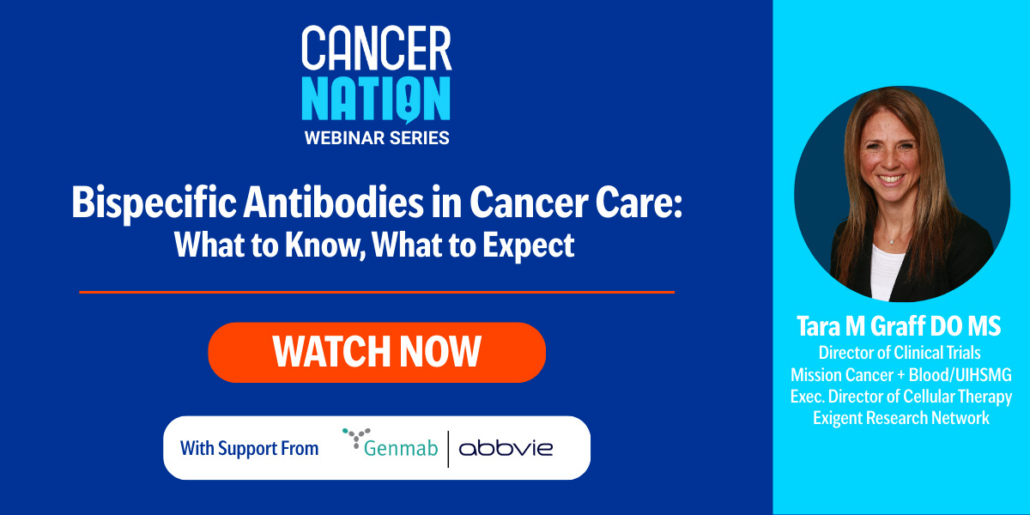
Webinar – Bispecific Antibodies in Cancer Care: What to Know, What to Expect
Cancer Nation’s Webinar Series presents Bispecific Antibodies in Cancer Care: What to Know, What to Expect, with Tara Graff, DO, MS. Bispecific antibodies are a newer type of immunotherapy cancer treatment, currently more often used in later lines of therapy, mainly in blood cancers such as lymphomas and myelomas. This discussion will help patients and caregivers make sense of Bispecific antibodies — what they are, how they’re used in real-world cancer care, and what people can expect during the early phases of treatment.
Dr. Graff, Director of Clinical Research at Mission Cancer and Blood in Iowa, breaks down common symptoms and side effects, how treatment may feel day to day, and how to communicate clearly and confidently with your care team. She also discusses what survivorship may look like after treatment and what questions patients and caregivers may want to ask along the way.
Following Dr. Graff’s presentation, Cancer Nation CEO Shelley Fuld Nasso moderates a Q&A session that includes questions from the webinar audience of patients, advocates, and professionals.
Watch the webinar below or here on YouTube.
Video Chapters and Resources
Webinar Chapters:
- 00:00 Introducing Dr. Tara Graff
- 01:39 Why this topic matters
- 03:21 What are Bispecific Antibodies? When are they used?
- 05:02 Bispecifics in Lymphoma & Myeloma
- 09:47 Patient Clinical Journey, Consensus Guidelines
- 14:29 Reported Side Effects, Toxicities
- 18:37 Clinical Side Effect Mitigation
- 21:24 What patients & caregivers can expect, common questions
- 27:36 Infection Risk, Late Toxicity
- 29:20 Resources & Education for Patients
- 31:00 Q&A
- 31:43 Providing Bispecifics in communities vs. cancer centers
- 37:26 What are the responsibilities for caregivers?
- 41:06 Bispecifics Clinical Trials of other cancer types
- 42:39 Survival rate discussion
- 45:05 Where do bispecifics fit among other treatment options?
- 48:54 How do you monitor for side effects?
- 53:29 How do your patients compare this treatment with others?
Related Resources:
- Webinar Slide Deck: Bispecific Antibodies in Cancer Care
- From the journal Blood: Consensus recommendations on the management of toxicity associated with CD3×CD20 bispecific antibody therapy (co-written by Dr. Graff)
- Blood Cancer United (LLS): www.bloodcancerunited.org
- Lymphoma Research Foundation: www.lymphoma.org
- International Myeloma Foundation: www.myeloma.org
- CancerCare: www.cancercare.org
- National Cancer Institute: www.cancer.gov
This webinar is presented by Cancer Nation, and supported by an unrestricted educational grant from Genmab.
About Tara Graff, DO, MS
 Tara M. Graff, DO, MS, first earned a master’s degree in Immunology from Loyola University Chicago. After medical school and residency training, she completed her fellowship in Hematology and Oncology at the Medical College of Wisconsin.
For over a decade, she has served patients at Mission Cancer and Blood in Des Moines, Iowa, where she specializes in CLL and NHL. She leads as Director of Clinical Research, playing a integral role in developing the joint clinical trial program with the University of Iowa.
Nationally, Dr. Graff contributes her expertise through multiple leadership positions. She serves on the National Lymphoma Advisory Boards, NHL Advisory Council, LBCL Steering Committee, ECOG’s Clinical Trial Organization, and the CIBMTR Lymphoma Working Committee, and also works with the Lymphoma Research Foundation. She partners with the Leukemia & Lymphoma Society to expand education for rural cancer patients and to train community oncologists on CAR-T and bispecific therapies.
As Principal Investigator on numerous clinical trials and author of many peer-reviewed publications, Dr. Graff has helped advanced care for patients with lymphoma. She is also the Executive Director of the Cellular Therapy Program at Exigent Research, where she chairs the Malignant Hematology Council. Through Exigent and her own initiatives, she has helped operationalize bispecifics across more than 20 community sites nationwide.