COVID-19 and Cancer: A Conversation with Cancer Control Expert Otis Brawley, MD
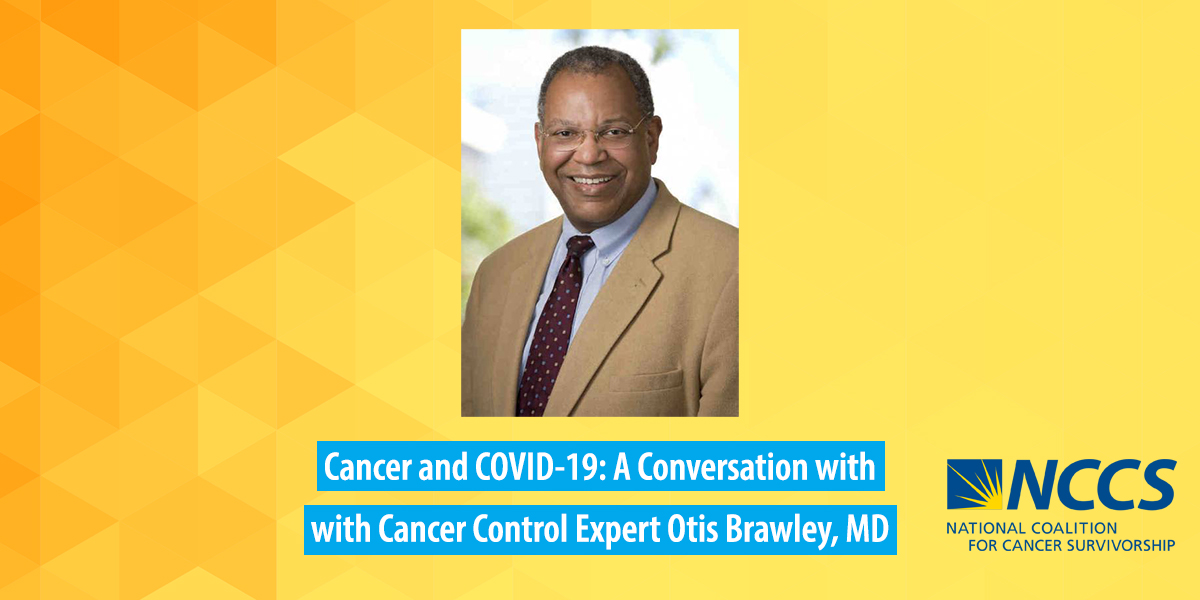
NCCS has been collecting questions from patients and survivors on the coronavirus crisis and decided to address these questions through a series of webinars and podcasts. Last week, NCCS hosted a conversation with cancer control expert and epidemiologist Otis Brawley, MD.
Watch the full video conversation and read excerpted portions below.
Download the full transcript » [PDF]
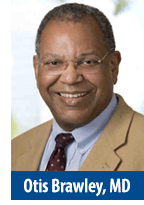 NCCS CEO Shelley Fuld Nasso moderated the discussion. “We knew exactly who we wanted to be our first guest speaker in this series. Dr. Otis Brawley is a Bloomberg Distinguished Professor at Johns Hopkins University, an oncologist and an epidemiologist. He’s also a truth teller, a myth buster, a straight shooter, and an all-around nice guy. When we called him last week to ask for advice on how we can best serve cancer patients during the scary and unpredictable season, his response was simple. ‘Just be honest with them,’ he said.”
Dr. Brawley started his opening comments talking about the nature of the coronavirus that causes COVID-19, saying, “Many of us have had coronaviruses and we just thought we had a cold. Indeed, some people who do well with the COVID-19 virus do well with it because they have had previous exposure to coronaviruses and it causes a partial vaccination, so to speak.”
Dr. Brawley also described who is at higher risk for the disease:
The immunocompromised—certainly people who have lung disease like COPD and asthma, people with diabetes, people with bad cardiac disease like congestive heart failure. We have some evidence that people who have hematologic diseases–leukemias, and lymphoma are at higher risk than people who have solid tumor diseases.
However, there is some data from China that people with GI and lung cancers and people with metastatic disease are at both higher risk getting the disease, and higher risk of not doing well from the disease, compared to the normal population.
Dr. Brawley addressed the mask issue:
The N95 masks that many people use in hospitals many healthcare providers use, EMS use, for example, those masks actually can protect the individual from breathing in the virus. The normal paper or cloth masks that we use in the operating room, or the people will use out in the public actually prevents the wearer from sending more particulates out into the air that other people can breathe in.
So the way to think about this recommendation recently for wearing the mask is, the assumption is the person wearing the mask may be spreading the infection and the mask prevents the spreading of the infection. It doesn’t protect the person who is wearing the cloth mask. One of my colleagues actually said, “Not wearing the mask in public is not suicide, it may be homicide.”
Brawley explained that there is a good reason for the new recommendations for wearing masks. “Many experts are now of the belief that perhaps half of all people who get infected with COVID-19 have no symptoms whatsoever,” he said, “and they may be totally asymptomatic, walking around shedding the virus.”
Dr. Brawley said that since this is a new disease and the screening around the country hasn’t been robust, “I can only say 20 percent of people who get symptomatic end up going to the hospital and less than half of them end up in near-respiratory arrest, or respiratory arrest requiring a ventilator.”
Dr. Brawley also described how cancer care delivery has been affected:
Brawley had a message for those touched by cancer:
This is a really difficult time. My recommendation to anyone who has cancer or anyone who lives with someone who has cancer is to stay indoors, stay away from other people, do all the things that we’ve been talking about: hand-washing, avoid people by six feet if you have to go out.
Indeed, we all need to try to be supportive of each other and try to prevent the spread of this disease until we can come up with some type of a vaccine which would be useful in preventing people from getting sick from it.
COVID-19 Webinar Series
Sign up for NCCS emails to get updates on future webinars in your inbox.
Q & A
Following opening comments, NCCS CEO Shelley Fuld Nasso conducted a Q and A with Dr. Brawley. Selected questions and answers, lightly edited for clarity, are below.
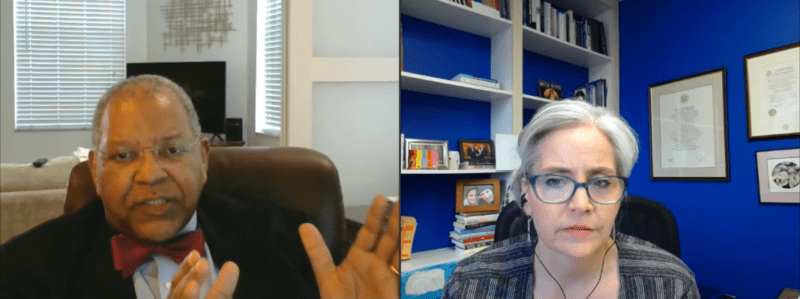
Otis Brawley, MD and NCCS CEO Shelley Fuld Nasso.
Are cancer survivors are at greater risk [for COVID-19] even after treatment? Or suffering worse effects if they get it? And how does the type of cancer, treatment modality, and the length of time from treatment matter in assessing risk?This disease is so new, no one has definitive answers to those questions. Those studies have yet to be done. Indeed, we need to study those over time, and we need to study cancer patients and non-cancer patients who get COVID and do well, but do they have sequelae? For example, in the 1917-1919 Spanish flu, people who got that were at a higher risk of Parkinson’s disease as they got older.
But the answer to your question is we don’t know. The Chinese have told us that people who have hematologic disease that is active don’t do well when they get infected. I am personally very concerned about people who got adjuvant chemotherapy for breast cancer or colon cancer a year or two ago and have finished that. We know that their immune systems are still damaged, if not totally recovered, from that adjuvant chemotherapy. So I worry about them, but I have no data on them, I don’t think anybody has data.
For cancer survivors who have completed treatment how should they think about regularly scheduled scans, testing, and follow-up appointments? I know there’s been a lot of movement toward telehealth, but you can’t do a follow-up scan by telehealth. How should they think about that?
People who have non-aggressive tumors—these are the folks who have [something] other than the fast-growing lymphomas, other than the very fast-growing breast cancers—most of those people, who should always talk to their doctor about this, their doctor is going to, I think, explain to them that they can delay the every-three-month or every-four-month CT scan looking for relapse right now. The risk of them being exposed while they’re out and about going to the doctor, and the doctor’s office and so forth, is such that those every-three-month and every-four-month CT scans for surveillance, in most diseases can be put off right now. You can miss one, we’ll catch up in July or August when things are a little bit better.
The folks who have the things that grow fast, like the Burkitt’s Lymphomas that just went into complete remission in the last couple of months, who are getting CT scans every three months—they need to talk to their doctors. For them, I think it is worth the risk and they ought to be getting those CT scans still. But it’s going to depend on the disease. Most people can skip going to the doctor, and we have converted at [Johns] Hopkins—most of our outpatient follow-up is being done by videoconferencing right now, and that’s working out well.
We’ve heard about treatments being delayed or cancelled, and you talked about the decisions in some cases to forgo the adjuvant chemotherapy, and that patients are skipping appointments that are not absolutely necessary. How are patients supposed to think about what is absolutely necessary? And what is your advice to someone who learns that their adjuvant chemotherapy is now not recommended, which gives them a higher risk of recurrence?
I’m hoping that you have a good relationship with your doc and you can talk to him or her. There are some people whose adjuvant chemotherapy is going to reduce your risk of relapse by 10%, and maybe your risk of getting COVID-19 is high, and the risk of not doing well is high, and so a 10% reduction is not worth it. There are other people where adjuvant therapies is going to reduce their risk of relapse by 40 or 50 percent. And there are some doctors who are really trying to talk to the patient over Zoom or WebEx and trying to figure out what the patient’s values are. There are certain patients who should get the adjuvant chemotherapy right now, and we are giving them the adjuvant chemotherapy, but there’s a bunch of patients who can forego it.
Can you talk a little bit about patients who are in treatment for metastatic cancers and how is this affecting their treatment?
Many of the metastatic patients are still getting their chemotherapy and still getting treatment because the feeling is that if we were to let the disease grow during this period of time, it would be inappropriate. When it looked like the shutdown in the economy would only be 2 or 3 weeks, some of us were delaying that next cycle of chemotherapy. Now, quite honestly we need to have our economy shut down into June 1 at least, probably further. Now that it looks like we’re going to be going a much longer period of time, most oncologists are electing to give chemotherapy to people who have metastatic disease, unless there’s an occasional person—you see this sometimes with breast cancer especially—who has metastatic disease but their disease is quiescent. Yes it is metastatic, but it’s not growing. That person might benefit from observation right now as opposed to continuing some type of chemotherapy.
Should those in treatment or recent treatment be wearing N95 masks, especially if they’re going to their treatments? Would it help protect them?
The problem with an N95 mask—when I was fitted with an N95 mask, they put the mask on you, figure out what size you need to wear for your face, and then they spray this sweet-smelling stuff and they ask you, “can you smell or taste the sweetness?” And if the answer is yes, the mask is not fitting correctly. You’re not allowed to wear beards with an N95 mask, for example. And so my concern is—I like the idea of cancer patients wearing N95 masks—this is Otis speaking, this is not CDC policy—I like the idea of cancer patients wearing N95 masks, but on the other hand, I’m worried they’re not going to have them fitted correctly. And number two, I’m worried when we start saying “wear masks,” that that’s going to cause people to—I hate masks and I’m always fiddling with them and moving my hands up around my face actually puts me at greater risk than wearing a mask. So I like the idea of an N95 mask if the person’s wearing it correctly, and if it doesn’t cause that individual will start fiddling with their face.
There’s been a lot of talk about in-home infusions for some cancer patients, and anecdotally we’ve heard some mixed views from patients. Some were in favor of it because it would help them manage their risk, and others had concerns about safety. We also heard mixed views from providers from a safety perspective. What are your thoughts?
Certain drugs I think can be administered at home, by usually a visiting nurse or someone who is skilled at doing that sort of thing. Certain drugs I think ought not be administered at home. For example the taxanes, Taxol and Taxotere, we have a good 3 to 5 percent of people who get those drugs have an allergic reaction to them. I want them to be in a medical environment that was able to give them more than just a shot of epinephrine for wheezing and shortness of breath. So there’s certain drugs where I think home infusion is fine, and there’s certain drugs where I would rather not see home infusion. I think that person ought to come to the hospital, or to the doctor’s office if they truly need that drug. Also, by the way, one other thing to keep in mind many of these chemo therapies are themselves carcinogens. I’m going to be concerned about exposure of people in the house to the leftover drug and that sort of thing. We have to be very mindful of that too.
Even as we’re talking about risk, we’re getting a lot of questions from from patients about their specific care and how it may be altered or interrupted due to the coronavirus and about their specific risk. Can you give some advice to cancer survivors about how to communicate with their doctors during this time?
Yeah, I actually think—I am heavily into being open and honest. “Doc, this is what’s on my mind.” The first thing that’s going to be on a lot of people’s mind, “is my cancer growing while I’m not getting treated? Am I going to be worse off because I’m not getting treated?” I’m really into open, honest communications. If you can’t have a good, open conversation with your oncologist, perhaps he or she should not be your oncologist. Unfortunately, this is a fine time to change doctors!
We’re hearing from some metastatic patients who are hearing about rationing ventilators, and that if they need care they shouldn’t admit that they’re that they have metastatic cancer. Are these types of decisions happening anywhere yet in the United States or are they just a grim possibility that we’re preparing for?
I am not aware that rationing of ventilators is happening in the United States at this time. I am aware of some emergent transportation of ventilators from one hospital to another, happening in New York—New York City, so there was not a shortage of ventilators. I really do encourage people to be very honest with their healthcare providers about their past medical issues. Some elements of their past medical history are going to be incredibly important. Certain drugs I would not use, for example, in people who have been treated for metastatic cancer. Even people who’ve been treated to complete remission from metastatic cancer, so please be open and honest about that. I hope nobody ever has to go onto a ventilator, but I am not aware in the United States at this time of anyone being deprived of a ventilator because of—they wanted to go on to the ventilator and they had a past medical history of something, or they wanted to go on a ventilator and they were of a certain age.
In planning for the potential of these shortages of ventilators, some institutions have may have had guidelines that include terminal cancer in the group of people who would be offered supportive care. But as we all know, many people live with stage 4 cancer for many years and and can be very stable with that, but yet it would still consider that to be a terminal cancer. You told us a different definition of terminal cancer, so can you talk a little bit about that and then should we be advocating for more specific guidelines rather than this broad brush of terminal cancer?
Terminal cancer, in the mind of an emergency room doc, I believe, is someone who has cancer and is going to die of that disease over the next six to eight weeks or sooner. It’s distinctly different from stage 4 disease. I say that because one of my dear friends is a patient that I took care of in 2002 and 2003, and we diagnosed her with metastatic breast cancer to brain back then, and I still talk to her. She’s living with metastatic disease now for 18, 19 years. There is a difference between stage IV and terminal. Now there are some people who have stage 4 disease who are terminal. There are some people who have congestive heart failure who are terminal as well. By the way, we have really good data to show that people who are very sick who go on to the ventilator—going on to the ventilator, by the way, is not a pleasant experience at all. Many people who have come off of it have described it as being waterboarded. I’ve actually had patients who said “I never want that experience again—don’t put me on the ventilator again.” Keep in mind, the people who they are saying “don’t put me on the ventilator” are the people who are very likely never going to come off of a ventilator alive.
I want to turn now to talk a little bit more about disparities. You did talk about some of the disparities and outcomes and there’s been a lot of reporting in recent days about higher death rates for African Americans diagnosed with COVID-19. Dr. Fauci acknowledged these disparities in the daily White House briefing earlier this week, and also there’s been reporting that the death rate has been higher for Latinos in New York. What do we know about the reasons behind this? Is this just a function of the disparities we already see in cancer care that are now coming to light in a much more public way with this? What can be done in the short term? I know some of these are factors systemic to the healthcare system, but are there any things in the short-term that could be done to make a difference to stop this crisis in African American communities?
I think Dr. Fauci was incredibly appropriate in talking about those disparities. I think the only thing we can do right now is try to make sure that every human being, no matter what their race or ethnicity or credit score is, has adequate care—for all things. One of the problems I have is the president said we’re going to pay for everybody’s COVID care. Well, what about their diabetes and congestive heart failure underneath that that’s actually going to increase their risk of 1) getting COVID and 2) not doing well with COVID as well? I’m really into giving adequate care to everybody. By the way, the incidence rate in poor people is probably lower than the incidence rate in middle class people, because poor people don’t have a doctor who can—I ran into this just yesterday, somebody called me and asked [if I] would I write them an order for them to get tested for COVID-19. You have to have a doctor’s permission to get tests—poor people don’t have relationships with doctors. They may have a relationship with a clinic that’s giving them their diabetes medicine but that’s not same as having a relationship with a doctor. Right now I think the most important thing to do is to try to give everybody the care that they need.
I’m going to look into my crystal ball and predict that—we’re talking about disparities in Blacks and Hispanics and in the big cities right now—two months from now, I think we’re still gonna have this problem out there, but we’re going to be talking about the disparities in poor whites in the southern United States. Because we’ve had a couple of states, Georgia being one of them, where the governors made some absolutely stupid decisions in delaying closing things down and we’re going to see spread into the white, poor rural population in Georgia, in Arkansas, and in a couple of other states.
I’d like to turn to clinical trials. We know that clinical trials have halted enrollment, some clinical trials have. Some research labs have been closed, some cancer researchers are being pulled into COVID-19 research. Tell us a little bit about the current state of cancer research and then what is it going to take to recover after COVID-19 is no longer an emergency?
Almost all the cooperative groups have shut down accrual to most of their trials. People who are going on the trials for very aggressive cancers like the aggressive lymphomas and leukemias are still being enrolled, but the adjutant therapy trials and so forth have been shut down. At the major universities, the laboratories have all been shut down. At Hopkins we’re allowed to go keep our cell cultures alive, keep our lab animals alive, but we’re not doing any cancer experiments at least for the time being. So we’re all on ice, that’s gonna set us back for at least three to four months after the reopening. If we’re shut down for three months, this is a six-month shutdown, this is going to set us back six months.
This is a huge problem for all of cancer, there’s just no way of getting around it. I have no better answers. We do need to be in a position where we can start it up as quickly as possible afterwards. I have yet to see nurses and clinical trial specialists being laid off or anything by any of the major hospitals. But I’m worried about the hit that the major hospitals are going to take over time, and that could even causing more harm to what’s going on. This is—this is bad. It’s just bad.
Is there anything that we as patient advocates can be doing to advocate for that when the time comes that we can reopen? Sometimes we feel a little bit helpless here–we know it’s bad but what can we do to help?
Try to make sure that your congressmen and Senators have in their mind that they need to support the hospitals, they need to support the research infrastructures—it’s not just cancer, it’s HIV, it’s cardiac, it’s a number of other diseases as well. You make sure that the congressmen and Senators have that in mind. I’ve heard a lot more about bailing out the restaurants than I’ve heard about bailing out medical infrastructure—I support both by the way, I support bailing out both.
I have one last question for you, and this is the one I keep coming back to in our staff meetings, and in my own life with my kids: Do you see any silver linings here? And when we come through this emergency, any silver linings that will help the cancer care, cancer research, the cancer experience for cancer patients?
The medical community has come together and been united in a way that I haven’t seen. We didn’t have this one—I was a young doc when we had HIV come forth in the 1980s. We were not united the way we are today for HIV. I think a whole bunch of doctors went back and read what they put in their essays that they wrote when they were applying to medical school, and a whole bunch of us actually realized why we really should have gone into medicine. I think we’ve got a much greater respect for nurses and the laboratory personnel, even the folks who clean the floors in the hospital. I was very moved the other day, I heard that the chair of ENT at the Cleveland Clinic found that he couldn’t be helpful in patient care, and so he went and got a mop and bucket and was mopping the floor with the folks from housekeeping. I think the human aspect has come out of a lot of us, so that’s perhaps the one big positive.
NCCS thanks Dr. Brawley for sharing his time and expertise with us and providing us with clear and concise information. Watch the full interview at the top of this post.
Download the full transcript » [PDF]
NCCS Coronavirus COVID-19 Resources for Cancer Survivors »
About Otis Brawley, MD
Otis Brawley is a globally-recognized expert in cancer prevention and control. He has worked to reduce overscreening of medical conditions, which has revolutionized patient treatment by increasing quality of life and reducing health disparities.
Brawley’s research focuses on developing cancer screening strategies and ensuring their effectiveness. He has championed efforts to decrease smoking and implement other lifestyle risk reduction programs, as well as to provide critical support to cancer patients and concentrate cancer control efforts in areas where they could be most effective. Brawley currently leads a broad interdisciplinary research effort on cancer health disparities at the Bloomberg School of Public Health and the Johns Hopkins Kimmel Cancer Center, striving to close racial, economic, and social disparities in the prevention, detection, and treatment of cancer in the United States and worldwide. He also directs community outreach programs for underserved populations throughout Maryland.
Brawley joined Johns Hopkins University as a Bloomberg Distinguished Professor in 2019 from the American Cancer Society and Emory University.
More About Cancer and COVID-19
https://canceradvocacy.org/news/l-imani-price-cancer-survivors-cope-anxiety-covid-19-coronavirus/
https://canceradvocacy.org/blog/coronavirus-cancer-resources-for-survivors/